
Blog
Do Mechanical Switches Top Membrane Keyboards?
With the increasing demand for computer-based office work, e-sports gaming, and content creation, keyboards have become an indispensable input device for people’s daily work and entertainment. Faced with a wide variety of products on the market, many consumers wonder: should they choose a mechanical keyboard with a mechanical keyboard switch, or a membrane keyboard?
This article will analyze the working principle, input experience, durability, application scenarios, and purchasing advice of mechanical keyboard switches to help you understand whether to choose a keyboard with a mechanical keyboard switch.
Understanding How Keyboard Switch Technologies Work
How Does a Mechanical Keyboard Switch Work?
First, let’s understand the internal structure and working method of a mechanical keyboard switch. Each key in a mechanical keyboard switch is equipped with an independent switch structure. Each keyboard switch consists of multiple components, including a slider, spring, metal contacts, and a housing.
When a user presses a key, the slider moves downward along a preset guide rail, compressing the internal spring. When the slider reaches the set trigger position, the metal contacts are activated, and the keyboard controller immediately recognizes the key signal and sends the input information to the computer.
Because each key has an independent mechanical structure, each switch maintains relatively consistent actuation performance and is not affected by adjacent keys. This allows mechanical keyboard switches to provide stable tactile feedback and a precise actuation experience.
Furthermore, different keyboard switches can create different feel types (such as Linear, Tactile, and Clicky) by changing the slider structure, spring pressure, and internal design, allowing different users to choose the switch that best suits their typing habits.
The mature mechanical structure also gives mechanical keyboard switches a long mechanical lifespan. Many products on the market can now achieve a lifespan of 80 million or 100 million keystrokes, thus gaining widespread use in office, gaming, and professional input devices.
How Does a Membrane Keyboard Work?
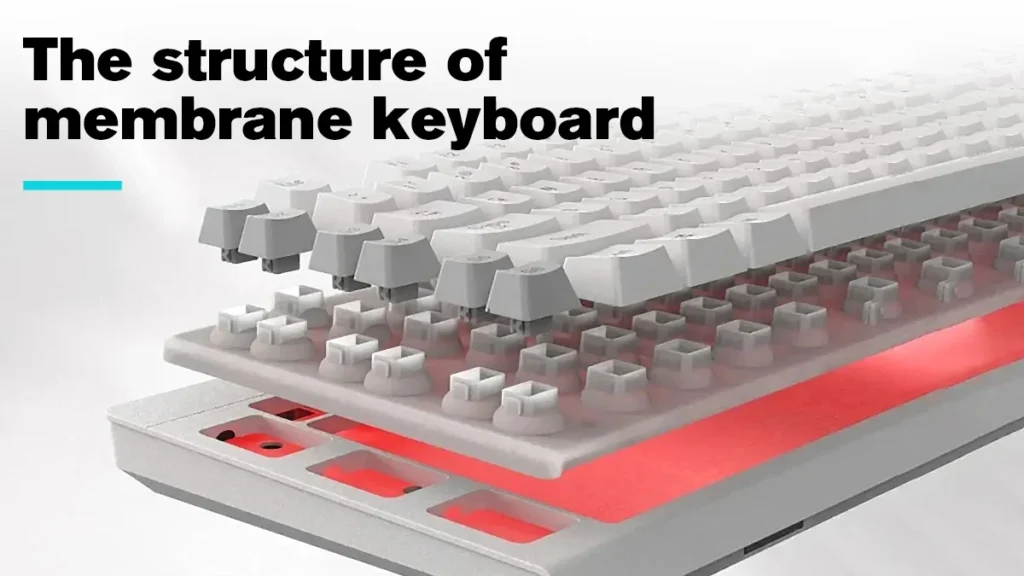
Membrane keyboards operate in a completely different way from mechanical keyboards. Internally, they mainly consist of multi-layer thin-film circuitry and rubber domes. When a user presses a key, the rubber dome first deforms, then pushes the upper conductive film into contact with the lower circuitry, creating a conductive state, and the controller recognizes the key signal.
Because multiple keys share the same membrane circuitry, membrane keyboards have a simple overall structure and lower manufacturing costs. Furthermore, their thinner overall thickness makes them easier to design in a slim and lightweight manner, leading to their widespread use in office keyboards, laptops, and some consumer electronics products.
Why Mechanical Keyboard Switch Provides a Better Typing Experience
More Consistent Keystroke Feel
For users who type a lot every day, key consistency significantly impacts the overall user experience. Each key on the mechanical keyboard switch uses an independent switch, ensuring that every press follows the same structural action. This high consistency across keys provides stable feedback regardless of typing speed.
This consistency advantage becomes even more pronounced over extended periods of typing. The key feedback force, actuation distance, and rebound speed remain stable over time, making it easier for users to develop muscle memory and improve typing efficiency. For programmers, editors, copywriters, and anyone who needs to use a keyboard for long periods, this not only improves comfort but also reduces mis-presses caused by key inconsistencies.
Clearer Tactile and Audio Feedback
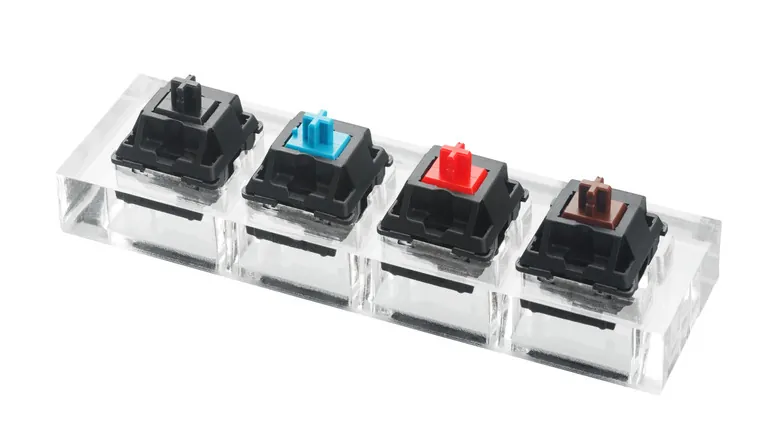
Another important reason for the mechanical keyboard switch’s popularity is its ability to offer a variety of keystroke feels:
- Linear keystrokes offer a smooth up-and-down movement without noticeable tactile feedback, suitable for users who prefer a fluid typing experience.
- Tactile keys offer a slight tactile bump at the actuation point, allowing users to clearly perceive when a key has been actuated, thus balancing office work and gaming experiences.
- Clicky keys, in addition to their distinct tactile feedback, also produce a crisp click sound, providing a more pronounced typing experience for users who prefer a clear, tactile feel.
In contrast, the Membrane Keyboard relies primarily on rubber domes for its tactile feedback, resulting in a more uniform feedback method and relatively limited options. Therefore, users who want to customize the keyboard feel to their liking tend to prefer the mechanical keyboard switch.
Faster and More Accurate Typing
Input efficiency is not only related to typing speed but also closely linked to key actuation methods. Mechanical keyboard switches have a clear actuation point; once the key reaches the actuation position, the input is complete, eliminating the need for users to press the key all the way down each time. This means less unnecessary key travel during continuous typing, improving overall input efficiency.
At the same time, the stable feedback provided by independent switches makes it easier for users to determine whether a key has been successfully actuated, reducing issues such as repeated typing, missed keystrokes, and accidental keystrokes. For programmers, large amounts of code input require high accuracy; for editors and writers, hours of continuous text input also necessitate stable key feedback.
In conclusion, the Mechanical Keyboard Switch helps users maintain typing speed while improving overall typing accuracy, reducing fatigue from prolonged typing, and providing a better experience.
Mechanical Keyboard Switch vs Membrane Keyboard in Daily Use
Typing Comfort Comparison
From a daily usage perspective, both keyboards have their suitable scenarios:
- Mechanical keyboard switches maintain a more natural typing rhythm during prolonged continuous typing, making them more suitable for scenarios requiring frequent keyboard use, such as office work, programming, and content creation.
- Membrane keyboards, on the other hand, are lighter and less expensive, meeting basic needs for everyday web browsing, simple document editing, and home use.
If only a small amount of text input is done daily, the difference between the two may not be noticeable; however, as typing time increases, the comfort advantage of mechanical keyboard switches becomes more prominent.
Durability Comparison
Durability is also an important factor for many consumers. Currently, most mechanical keyboard switches can withstand tens of millions or even hundreds of millions of keystrokes, meeting the needs of long-term, high-frequency use. Furthermore, throughout their lifespan, the keys typically maintain a high degree of consistency, providing users with a stable and reliable typing experience.
Membrane keyboards primarily rely on rubber for key presses and rebounds. With prolonged use, the elasticity of this rubber gradually decreases, potentially leading to reduced feedback and altered key feel in some keys, thus impacting the overall typing experience.
For enterprise purchases, large office environments, and professional users, higher durability not only translates to a longer product lifespan but also helps reduce later maintenance and replacement costs.
Maintenance and Customization
In recent years, more and more mechanical keyboards have begun to support richer personalization configurations. Users can change keycaps according to their preferences, height, and color schemes, or customize them to their specific needs. Many products now support hot-swappable designs, allowing for quick switch replacement without soldering, significantly improving maintenance efficiency.
Furthermore, a wide range of accessories, such as mounting plates, stabilizers, noise-reducing components, and internal filling materials, allow users to further adjust the keyboard sound and feel, creating an input device that better suits their individual needs.
In contrast, membrane keyboards have a highly integrated overall structure, with most products lacking switch replacement options and extensive customization possibilities, thus limiting upgrade and maintenance options. For keyboard enthusiasts, the high degree of customizability offered by the mechanical keyboard switch is also one of the important reasons for its popularity.
Future Development of Keyboard Switch Technology
In recent years, keyboard switch technology has experienced rapid and continuous development. Mechanical switches have seen constant optimization of their internal structure, achieving advancements in key consistency, mechanical lifespan, quiet operation, and manufacturing precision.
More and more keyboard switch manufacturers are launching new products. For example, low-noise switches meet the demands of quiet input in open office environments, while long-life switches meet the reliability requirements of gaming and high-frequency input devices, providing users with a wider range of choices.
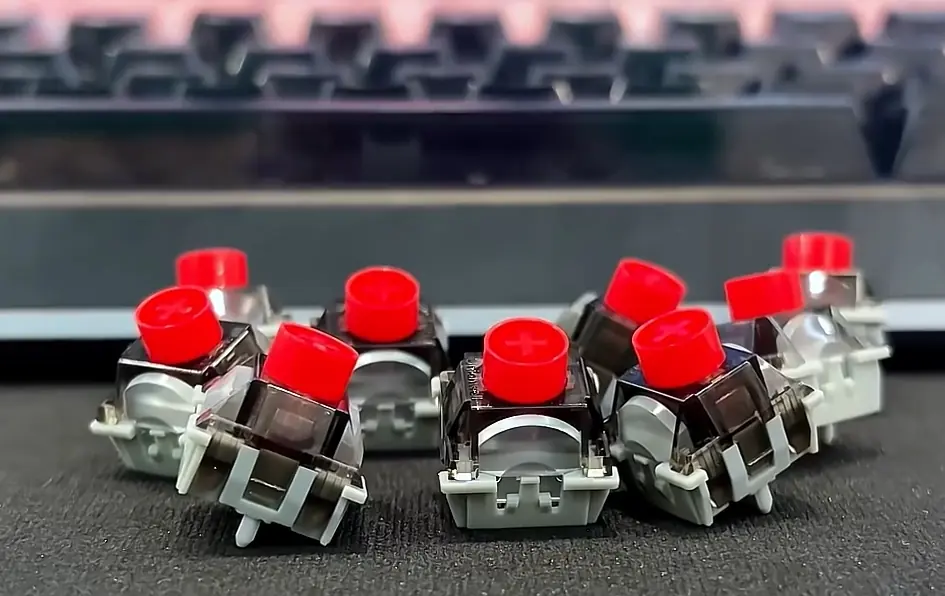
Meanwhile, new technologies such as magnetic and inductive keyboard switches are also developing rapidly. Magnetic switches utilize the Hall effect for non-contact detection, supporting functions such as Adjustable Actuation and Rapid Trigger; inductive switches utilize electromagnetic induction technology for key detection, bringing new technological directions to input devices.
(Magnetic Keyboard Switch)
In the future, various keyboard switch technologies will continue to evolve in different application scenarios. These new technologies will also continuously drive the entire keyboard industry towards higher performance, greater intelligence, and greater diversification, providing users with a wider range of product choices.
Conclusion
The biggest difference between a mechanical keyboard switch and a membrane keyboard lies in the key structure and typing experience. The independent switch design not only provides more consistent key feedback, a wider range of tactile options, and a longer lifespan, but also caters to various usage scenarios such as office work, gaming, programming, and content creation.
For users planning to buy a keyboard, it is recommended to consider their usage needs, budget, typing habits, and tactile preferences. If you desire a more comfortable, stable, and personalized typing experience, a mechanical keyboard with a mechanical keyboard switch is a worthwhile option to consider.