
Blog
What Is the Hall Effect in a Magnetic Keyboard Switch?
In recent years, the mechanical keyboard market has continued to develop, and more and more users are paying attention to magnetic keyboard switches. Besides mechanical keyboard switches, magnetic switches based on the Hall Effect are gradually becoming a new technology attracting attention from e-sports players, programmers, and keyboard enthusiasts.
Many consumers have heard of the Hall Effect, but do not understand its working principle and various functions. This article will delve into the working principle of the Hall Effect in magnetic keyboard switches, introduce its core advantages, differences from mechanical keyboard switches, applications, and future development trends, helping users to fully understand this keyboard switch technology.
What Is the Hall Effect in a Magnetic Keyboard Switch?
The Hall effect is a classic electromagnetic phenomenon, first discovered by American physicist Edwin Herbert Hall in 1879. When an electric current flows through a conductor or semiconductor material, if an external magnetic field perpendicular to the direction of the current exists, a voltage related to the magnetic field strength will be generated across the material.
This phenomenon is called the Hall effect. After more than a century of development, the Hall effect has been widely used in automotive electronics, industrial automation, consumer electronics, and other fields, and is now also a core detection technology in magnetic keyboard switches.

Edwin Herbert Hall
In a magnetic keyboard switch, each switch contains a small permanent magnet. When a key is pressed, the magnet moves synchronously with the switch, changing the magnetic field strength. A Hall sensor mounted on the PCB detects this magnetic field change in real time and transmits the result to the control chip. The control chip continuously analyzes the data collected by the Hall sensor and calculates the current position of the key based on the magnetic field changes. When the key reaches the preset trigger point, the system immediately outputs a key signal; as the key continues to move downwards, the system continues to detect its position change, rather than simply determining whether the key has been triggered.
Because the entire detection process relies on magnetic field changes and does not require physical contact between metal contacts, Hall Effect achieves a non-contact signal detection method. This not only reduces mechanical wear but also provides the technical foundation for advanced functions such as Adjustable Actuation and Rapid Trigger, giving the magnetic keyboard switch greater flexibility in input methods.
How Does a Magnetic Keyboard Switch Work?
Magnet Movement Inside the Magnetic Keyboard Switch
Inside a magnetic keyboard switch, the permanent magnet is typically mounted in the switch core. When a user presses a key, the axis moves up and down along the guide rail, and the magnet moves synchronously. As the distance between the magnet and the Hall sensor changes, the magnetic field strength also changes.
This change is continuous, allowing the system to acquire magnetic field information throughout the entire key travel, rather than detecting it at a fixed position. This not only identifies whether a key is pressed but also determines the distance the key is pressed, supporting richer input functions.
Hall Sensor Detects Position Changes
The Hall sensor is the core detection component of the magnetic keyboard switch. When the magnet moves, the Hall sensor continuously reads the changes in magnetic field strength and outputs the corresponding data in real time. It can continuously detect the entire key travel, allowing the system to execute different control logic based on different positions. This is also a key reason why Hall Effect can achieve adjustable trigger travel.
Controller Converts Magnetic Signals into Keystrokes
After the Hall sensor detects the magnetic field change, it sends the data to the keyboard control chip (MCU). The MCU continuously calculates the current magnetic field value and, combined with the pre-set trigger travel, determines whether a key signal needs to be output. Because the entire process is based on real-time data calculations, the magnetic keyboard switch can support dynamic adjustment of the trigger point while maintaining a fast response speed and a stable input experience.
Advantages of Hall Effect Magnetic Keyboard Switch
No Physical Contact Between Electrical Components
The biggest feature of the Hall Effect Keyboard Switch is that the entire signal detection process does not rely on metal contacts. Because there is no contact friction, the switch will not experience wear due to repeated impacts during long-term use, and performance fluctuations caused by oxidation or changes in contact conditions are reduced, maintaining stable and consistent input performance even after long-term use.
Higher Durability
Due to its non-contact detection method, the magnetic keyboard switch has a significant advantage in durability. Without mechanical wear, the switches maintain more consistent actuation performance, with relatively little change in feel over long-term use.
For gamers, programmers, and users who input frequently, this consistency provides a more stable operating experience. Many magnetic switch products have achieved a mechanical lifespan of over 100 million keystrokes, providing long-term reliable performance for the keyboard.
Adjustable Actuation Point
Adjustable Actuation is one of the main functions of Hall Effect technology applied to keyboards. Because Hall effect sensors can continuously detect the entire key travel, the control system can set different positions as trigger points without relying on fixed mechanical structures. Users can freely adjust the trigger travel in the software according to their needs (Note: the adjustable range may vary between different brands).
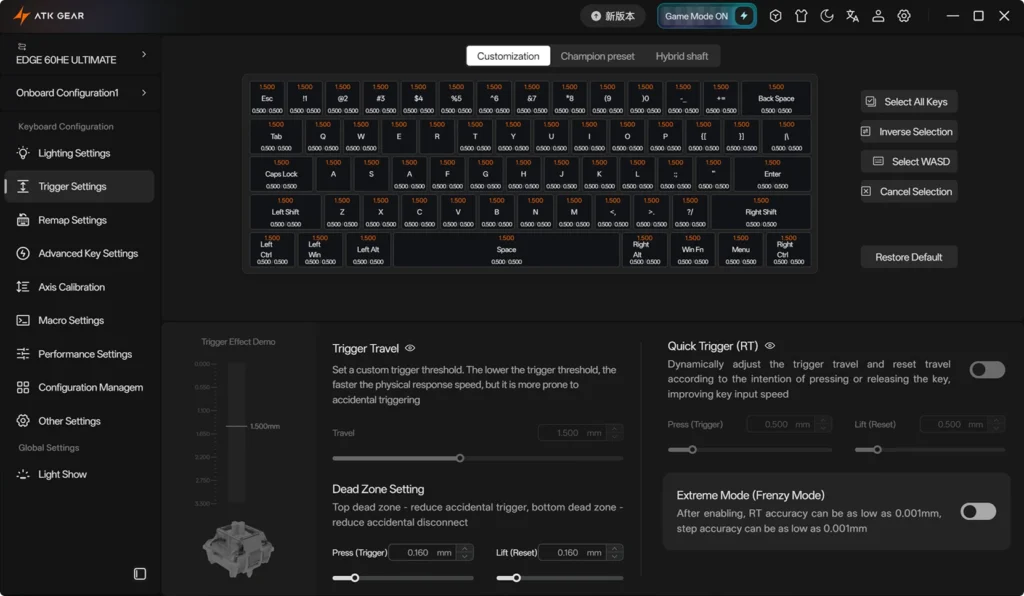
Adjustable trigger point page
For gamers, a shallower trigger point can shorten response time; for everyday office workers or text input users, a longer trigger distance can reduce accidental keystrokes and improve input accuracy. This flexibility allows a single keyboard to adapt to different usage scenarios and further enhances product customizability.
Rapid Trigger Technology
Rapid Trigger is another highly regarded feature of magnetic keyboard switches. In magnetic switch keyboards employing Hall Effect, the system continuously monitors the real-time position of the keys.
When a key begins to rebound, as soon as a change in position is detected, the system can re-determine the key’s state according to the settings, without waiting for the key to return to its fixed reset point. This allows users to complete the continuous actions of pressing, releasing, and pressing again more quickly, thereby improving continuous operation efficiency.
For quick stops, peeks, and fast movements in FPS games, and high-frequency skill releases in MOBA games, Rapid Trigger makes key responses more sensitive, providing higher input efficiency for competitive operations. Of course, whether this feature is suitable for a user depends on individual operating habits and the specific game type.
Magnetic Keyboard Switch vs Mechanical Keyboard Switch
Working Principle Comparison
Although both types of switches are used for keyboard input, they employ different technologies:
- The Mechanical keyboard switch relies on metal contacts for signal input. When a key moves to a fixed trigger position, the metal contacts engage, and the control system recognizes the key signal; therefore, its trigger point is determined by the switch structure.
- The Magnetic keyboard switch, on the other hand, detects changes in magnetic fields through the Hall Effect, continuously acquiring key position information using a Hall sensor. It does not require metal contact, enabling continuous position detection and supporting more flexible trigger control.
Performance Comparison
- In terms of response speed, magnetic keyboard switches can quickly determine input using real-time position detection, achieving more flexible response performance while supporting relevant functions.
- Regarding actuation point adjustment, the actuation position of mechanical keyboard switches is usually determined by their structural design, while magnetic keyboard switches can adjust different actuation positions via a driver, providing a more personalized input experience for different users.
- Rapid Trigger is one of the key advantages of Hall Effect technology, a feature currently lacking in mechanical keyboard switches that use metal contact detection.
- In terms of input consistency, due to its non-contact detection, magnetic keyboard switches can maintain stable actuation performance over long periods.
It’s important to emphasize that neither technology is inherently superior or inferior. For users who prioritize input experience, mechanical keyboard switches still offer a wide selection of switches and a mature market ecosystem; for users seeking adjustable actuation and gaming functionality, magnetic keyboard switches provide a more personalized experience.
Why Magnetic Keyboard Switch Is Better for Gaming?
In recent years, an increasing number of gaming keyboards have adopted magnetic keyboard switches because Hall Effect supports features such as Adjustable Actuation and Rapid Trigger, making it more suitable for competitive and casual gamers.
For competitive gamers, this allows them to adjust their input methods according to different game types, further optimizing the operational experience.
For casual gamers who prioritize an overall user experience, they can choose between a magnetic keyboard switch and a mechanical keyboard switch based on their needs.
For keyboard enthusiasts and custom keyboard enthusiasts, Hall Effect technology offers new avenues for exploration, providing them with more differentiated experience options.

Applications of Magnetic Keyboard Switch Technology
Today, Hall Effect is no longer limited to gaming keyboards; it’s gaining attention in the custom keyboard market. More and more brands are launching products that support magnetic switches, aiming to provide users with a more flexible input experience. Simultaneously, gaming peripheral brands and professional gaming equipment manufacturers continue to invest in Hall Effect technology research and development, constantly releasing software ecosystems that support adjustable triggers, multi-function keys, and intelligent configuration.
This trend is driven not only by the continuous maturation of the technology but also by changing user needs. As market acceptance increases, Hall Effect is expected to be applied in more products and drive continuous innovation in keyboard switch technology.
Future Trends of Magnetic Keyboard Switch
Higher Precision Hall Sensors
In the future, the development of Hall Effect technology will further rely on higher-precision Hall sensors. With continuously improving detection accuracy, magnetic field data acquisition will be more stable, allowing the system to more accurately identify key positions, thereby reducing input latency, improving trigger consistency, and supporting more advanced functions.
Integration with Smart Keyboard Software
Besides hardware upgrades, driver software will be a crucial direction for the continued development of magnetic keyboard switches. In the future, users will be able to adjust trigger travel in real time, manage configuration schemes for different application scenarios, and achieve cloud configuration synchronization, ensuring a consistent user experience across different devices.
At the same time, personalized configuration management will become richer, allowing users to quickly switch different parameters according to their gaming, office, or creative needs, making the keyboard a truly customizable input tool.
Conclusion
Hall Effect is the core technology for non-contact input detection in magnetic keyboard switches. It uses Hall sensors to detect changes in the magnetic field in real time, achieving continuous position sensing without relying on metal contacts. This provides higher durability, faster response speeds, and more flexible trigger travel settings.
As Hall Effect technology matures and intelligent driver software continues to develop, magnetic keyboard switches will evolve towards higher precision, lower latency, and greater intelligence. For keyboard manufacturers, choosing a keyboard switch manufacturer with independent R&D capabilities, precision manufacturing processes, and a rigorous quality management system will help create a new generation of keyboard products with superior performance and stronger competitiveness.