
Blog
How Does a Dual-Body Floating Structure Improve a Magnetic Keyboard Switch?
As keyboard technology evolves, switch actuation mechanisms are shifting from mechanical contact-based detection to non-contact magnetic sensing. Magnetic keyboard switches detect key displacement by monitoring the changing relative position between a magnet and a Hall effect sensor; this provides the technical foundation for features such as continuous travel tracking, adjustable actuation points, and “Rapid Trigger” functionality.
In magnetic keyboard switches, the magnet’s movement trajectory directly impacts the consistency of the detection signal. However, actual keystrokes do not always occur vertically. When a user presses the edge or corner of a keycap, the switch may tilt, wobble, or shift laterally, thereby affecting the magnetic field signal. To address this, the Polar Magnetic Keyboard Switch employs a dual-body floating structure that combines a ball-and-socket joint with a guiding mechanism to achieve coordinated movement. This article analyzes this structure in detail and explains how it optimizes magnetic switch performance.
What Is a Dual-Body Floating Structure?
Why Does a Magnetic Keyboard Switch Need a Dual-Body Structure?
A single-piece stem must withstand both vertical displacement and lateral forces simultaneously. When a user presses the edge of a keycap, the stem may experience a bending moment, causing the magnet to deviate from its ideal position. In magnetic keyboard switches, changes in magnet position directly affect magnetic field detection; even with identical downward travel, variations in the magnet’s lateral position result in different signals being received by the Hall effect sensor.
Consequently, the dual-body floating structure is designed to allow the force-bearing area to accommodate pressure from various directions while minimizing direct impact on the magnetic sensing module. Rather than completely eliminating mechanical error, it utilizes functional separation and relative movement to provide a more effective path for dissipating forces generated by off-center keystrokes.
The dual-body floating structure splits the single-stem movement system into two functional modules: one responsible for transmitting actuation force and the other for stabilizing the movement of the magnetic sensing component. Unlike designs where all parts are fixed to a single stem, this configuration redistributes the tasks of force transmission and movement stabilization.
The Movable Module and Floating Module of a Polar Magnetic Keyboard Switch
In the Polar Magnetic Keyboard Switch, when pressure is applied to the keycap, the Movable Module receives the input and—via a connecting structure—drives the Floating Module to execute the magnet’s displacement. The two modules work together to facilitate the downward stroke and the return movement, though they do not maintain perfectly rigid synchronization at all times.
The Movable Module connects directly to the keycap and bears the user’s operating force, serving to receive the downward pressure and transmit the key’s displacement. Since the surface area of the keycap exceeds that of the switch stem’s top, the point of application may be off-center; consequently, the module must accommodate forces applied from various directions. When the user presses the edge of the keycap, the Movable Module may generate an additional lateral moment, with a portion of the force transmitted to the magnet mounting area, potentially causing the magnet to tilt or shift laterally.
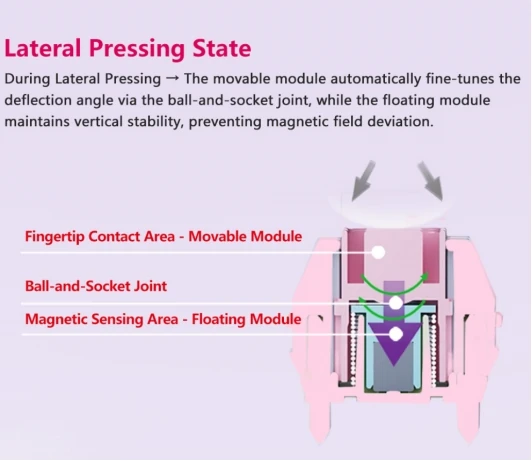
movable module and floating module
Therefore, a “Floating Module” is required to maintain the stability of the magnetic sensing component’s movement. The magnet is mounted on the moving part—aligned with the Hall sensor on the PCB—and must maintain a specific orientation to ensure it approaches or moves away from the sensor steadily. These two modules move in tandem via a specialized connection structure: the Movable Module responds to user input, while the Floating Module stabilizes the magnet’s trajectory, thereby minimizing the impact of lateral pressure on the magnetic sensing mechanism.
How Does the Dual-Body Floating Structure Work in a Magnetic Keyboard Switch?
The dual-body floating structure relies on controlled relative movement between the two modules. When the key is pressed, the Movable Module responds first to the user’s input and then drives the Floating Module via the connecting mechanism to displace the magnet. This structure must satisfy three conditions: the connection between modules must be strong enough to reliably transmit displacement; the connection area must allow for limited angular adjustment to absorb lateral interference; and the Floating Module must be properly guided to prevent excessive, uncontrolled wobbling.
Ball-and-Socket Joint: The Key Connection of a Magnetic Keyboard Switch
The ball-and-socket joint is the critical connecting component in the dual-body structure; consisting of a spherical end and a corresponding socket, it creates a mechanical connection with limited degrees of freedom between the two modules. Unlike a completely rigid connection, the ball-and-socket joint allows for a degree of adaptive angular adjustment between the Movable Module and the Floating Module. When the keycap is subjected to off-center pressure, the Movable Module may tilt slightly, while the Floating Module does not need to replicate this tilt.
This reduces mechanical interference caused by off-center pressing. The Movable Module bears the primary lateral torque, with the connection area providing angular compensation via the spherical contact surface, while the Floating Module remains relatively stable under the constraints of the guiding structure. In the case of the Polar Magnetic Keyboard Switch, the ball-and-socket joint minimizes the risk of the magnet shifting laterally or tilting, ensuring the magnetic sensing component is not entirely dependent on the direction of force applied to the keycap and stem.
How Does a Magnetic Keyboard Switch Handle Off-Center Key Presses?
During a direct vertical press, the Movable Module and the Floating Module move downward in unison; the magnet approaches the Hall sensor along a predetermined path, generating a stable change in the magnetic field. When subjected to off-center or lateral pressing, the Movable Module experiences an additional moment and undergoes slight deflection. Because the ball-and-socket joint allows for a degree of relative adjustment, this deflection does not force the Floating Module to tilt in unison.
Constrained by the housing guides and internal structure, the Floating Module continues to execute its primary vertical displacement while limiting the extent of lateral movement, thereby better accommodating the varied pressing angles encountered across different positions on a real keyboard.
How Does a Dual-Body Floating Structure Improve Magnetic Keyboard Switch Signal Stability?
Maintaining a Consistent Magnet-to-Sensor Position
The detection logic of magnetic keyboard switches relies on measuring changes in the relative position between the magnet and the Hall effect sensor to track key travel. If the magnet undergoes lateral shifting or tilting, the detected magnetic field changes may deviate from expected values. The dual-body floating structure addresses this by using a “Movable Module” to absorb pressure from various directions, thereby stabilizing the movement of the “Floating Module” and helping to maintain a more consistent magnet-to-sensor position.
Reducing Magnetic Signal Variation During Key Travel
Furthermore, the dual-body floating structure minimizes the impact of lateral mechanical displacement on the magnetic sensing zone through angular compensation provided by a ball-and-socket joint and the independent guidance of the Floating Module. However, signal stability is not determined solely by the dual-body structure; other parameters—such as magnet dimensions, magnetic materials (N-52 magnets), Hall sensor installation precision, and PCB tolerances—are equally critical.
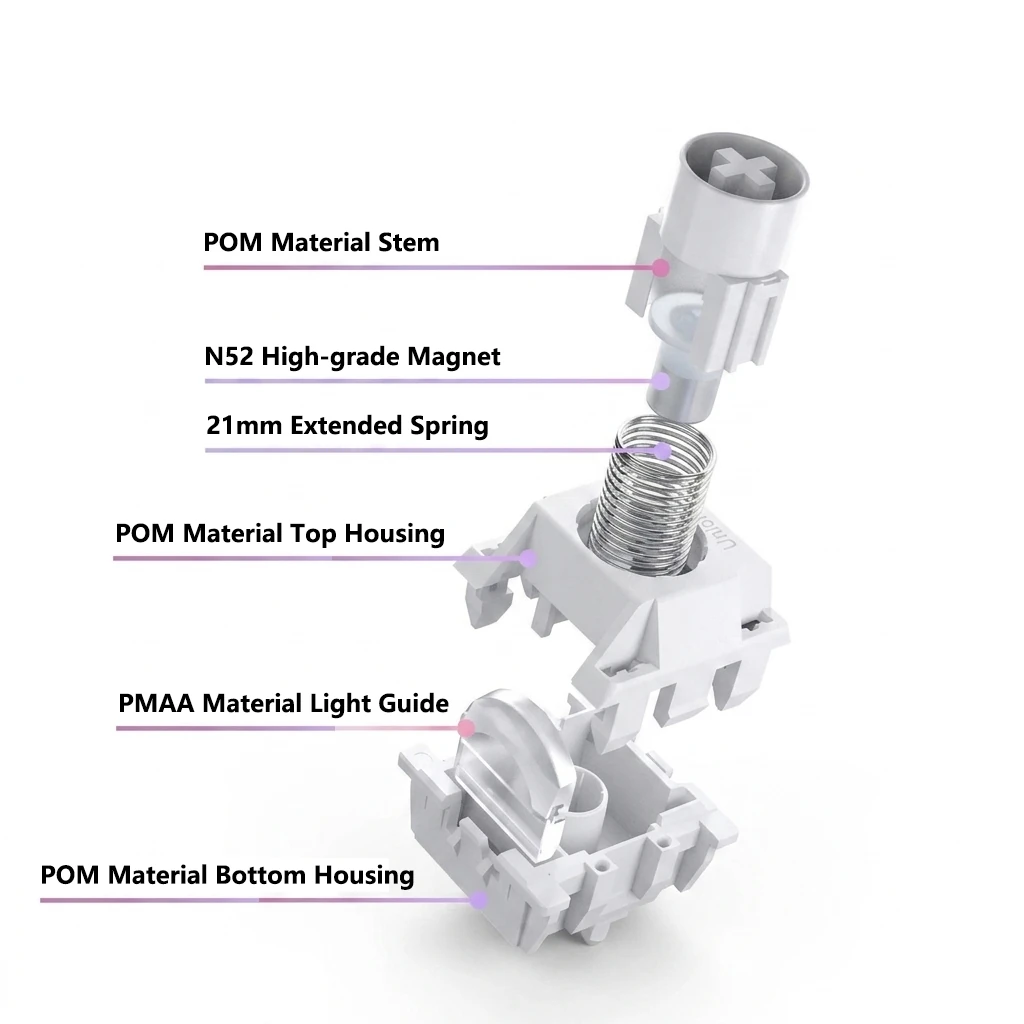
polar magnetic keyboard switch details view
How Does the Dual-Body Floating Structure Improve Magnetic Keyboard Switch Feel?
Reducing Stem Wobble in a Magnetic Keyboard Switch
Stem wobble typically manifests as lateral looseness in the keycap when it is unpressed or subjected to light pressure. For magnetic keyboard switches, stem wobble not only affects the typing feel but can also alter the relative position of the magnet.
POM stems offer excellent sliding properties and dimensional stability, making them ideal for frequent reciprocating motion. The split-body structure connects two modules via a ball-and-socket joint; this allows for unified movement while providing space to dissipate lateral forces.
When a user presses the edge of the keycap, any slight deflection in the “Movable Module” is not fully translated into lateral wobble in the “Floating Module.” Combined with the internal guide surfaces of the housing, the switch mechanism maintains a more focused vertical motion, thereby reducing stem wobble.
Improving Smoothness and Bottom-Out Feedback
Some “Polar” magnetic keyboard switches utilize POM stems paired with extended springs (21mm or 23mm) to ensure a smooth actuation and return process. The POM material minimizes friction between the stem and the guide structure, resulting in more fluid movement.
The ball-and-socket joint within the dual-body structure reduces the risk of binding caused by off-center presses, while the extended spring influences return speed, actuation force dynamics, and the reset process. However, the dual-body structure is not the sole determinant of typing feel; bottom-out feedback, sound, and smoothness are also influenced by factors such as the housing, spring, and keycap weight.
How Does a Dual-Body Floating Structure Support Rapid Trigger?
Magnetic keyboard switches detect continuous displacement via magnetic field changes, rather than simply registering a binary contact connection or disconnection. This capability for continuous detection provides the foundation for adjustable actuation points and the “Rapid Trigger” function.
Stable Travel Detection for Adjustable Actuation
Adjustable actuation requires the control system to accurately identify signal changes generated by the magnet at various positions. If the magnet’s trajectory is stable, it becomes easier for the software to establish a precise correlation between key position and magnetic field signals.
The dual-body floating structure separates the functions of the “Movable Module” and the “Floating Module,” ensuring that the magnet maintains a relatively consistent path of motion regardless of the pressing technique. This helps minimize variations in the actuation point caused by mechanical misalignment, ensuring that the displacement detected by the system more accurately reflects the true vertical travel.
Supporting Rapid Trigger and Fast Reset
“Rapid Trigger” functionality requires real-time detection of displacement changes during key release. If the magnet undergoes unintended lateral shifting due to stem tilt, the sensor may receive signals that do not precisely correspond to the actual vertical travel. The stable movement facilitated by the Floating Module mitigates this effect, ensuring the magnet moves primarily along the intended axis; this enables the control system to more accurately determine actuation and reset states.
What Are the Benefits of a Dual-Body Floating Structure for Keyboard Manufacturers?
More Consistent Magnetic Keyboard Switch Performance
For magnetic keyboard switches, stable mechanical movement is the foundation of product consistency. Switches must maintain relatively consistent movement characteristics across various pressing angles, user habits, and prolonged, repetitive use.
The dual-body floating structure separates the functions of the “Movable Module” and the “Floating Module,” thereby reducing the direct impact of off-center presses on the magnetic sensing components. This significantly lowers defect rates during mass production.
Better Support for Gaming and Custom Keyboard Applications
Esports keyboards prioritize rapid response, continuous input, and adjustable actuation points; the dual-body floating structure enhances mechanical stability. This stable structure provides a foundation for various parameter combinations, allowing manufacturers greater flexibility in tuning switch characteristics.
Furthermore, in the custom keyboard market, users have diverse requirements regarding actuation force, sound, actuation distance, and rebound characteristics. With high-frequency input devices, repetitive pressing can amplify minor mechanical flaws. Consequently, minimizing stem wobble and improving rebound consistency offer significant practical value.
Greater Flexibility in Magnetic Keyboard Switch Design
The dual-body structure—featuring a split stem, variable spring lengths, and integrated light-guiding components—enables a wide range of product configurations. Manufacturers can adjust actuation force, rebound speed, actuation distance, lighting effects, and aesthetics based on the keyboard’s market positioning, ensuring compatibility with the installation space and functional requirements of different keyboard platforms.
Conclusion
The dual-body floating structure offers a mechanical design alternative to traditional single-body stem designs for magnetic keyboard switches. By separating the functions of the Movable Module and the Floating Module, the keycap-bearing section and the magnetic sensing section no longer rely entirely on the same rigid movement path. Additionally, since the distance, angle, and trajectory between the magnet and the Hall sensor influence signal output, the stable Floating Module minimizes lateral shifting and tilting caused by off-center presses. This provides a reliable foundation for actuation detection, adjustable actuation points, and “Rapid Trigger” functionality.
Therefore, when selecting magnetic keyboard switches from keyboard switch manufacturer, brands and keyboard makers should consider innovative design approaches such as the dual-body floating structure and ball-and-socket joints. Only when the mechanical movement trajectory is well-coordinated with the electronic detection system can the magnetic switch maintain stable performance during rapid input, long-term use, and various pressing styles.