
Blog
The Complete History of Mechanical Keyboard Switch Development
In recent years, with the rapid growth of the e-sports, office, software development, and custom keyboard markets, mechanical keyboard switches have once again become a focus of industry attention. Some users not only pay attention to the feel of the switches but also to their technological evolution and structural innovations.
Understanding the development history of mechanical keyboard switches not only helps in understanding the differences between different switches but also helps users better choose the keyboard products that suit their needs. This article will introduce the background of the mechanical keyboard switch’s birth, key development stages, technological innovations, and future development trends, allowing you to understand this microcosm of the evolution of modern input devices.
From Typewriters to Mechanical Keyboard Switch
The Typewriter Era: The Origin of Mechanical Key Input
The history of the mechanical keyboard switch can actually be traced back to the typewriter era. In the mid-to-late 19th century, with the development of the Industrial Revolution, typewriters gradually entered the commercial office field. They adopted a purely mechanical structure, with each key corresponding to an independent mechanical transmission mechanism. When a user pressed a key, the key, through a linkage, moved the type bar to strike the ribbon, thus printing the characters onto paper, completing one text input.
To ensure input accuracy, each key in a typewriter required a stable travel distance and reliable rebound performance. Although fundamentally different from modern keyboards, the design concepts of independent keys, mechanical feedback, and key rebound already represented the rudiments of a keyboard switch. The pursuit of a superior keyboard input experience began as early as the typewriter era.

Typewriter
With the widespread adoption of computers in the 20th century, people’s needs for information input underwent a dramatic change. Since typewriters could not meet the new demands for electronic data input, information processing, and computer interaction, mechanical key technology began to evolve towards electronic keyboards. Designers retained the advantages of independent keys and mechanical feedback, while combining them with electronic circuitry to achieve a more efficient and precise input method, laying the foundation for the subsequent development of mechanical keyboard switches.
The Birth of the First Mechanical Keyboard Switch
After the 20th century, the computer industry developed rapidly, and electronic keyboards gradually replaced typewriters, becoming one of the most important input devices between humans and computers. To achieve stable and reliable character input, early computer keyboards generally adopted an independent mechanical switch structure.
Compared to typewriters, these electronic keyboards utilize mechanical switches to detect key presses: when a user presses a key, the internal mechanical structure of the switch activates the contacts, which in turn enable the control circuitry to identify the corresponding key signal and transmit it to the computer for processing.
The key feature of this design is that each key has an independent trigger mechanism, preventing interference between keys and providing more consistent and stable input. Even with prolonged continuous input, the keys maintain similar actuation distance and feedback force, effectively improving input efficiency and providing an important reference for the design of modern mechanical keyboard switches.
The Evolution of Mechanical Keyboard Switch Technology
Mechanical Keyboard Switch in Early Computer Keyboards
During the 1970s and 80s, as computers began to enter businesses, research institutions, and office environments, mechanical keyboards experienced rapid development. During this period, the focus of keyboard switch development was primarily on reliability, durability, and input accuracy.

The 20th Century Computers
Because computers needed to operate continuously for extended periods, keyboards had to withstand a large number of repetitive keystrokes. Therefore, manufacturers continuously optimized the internal structure of mechanical keyboard switches, improving contact stability, spring rebound performance, and overall mechanical lifespan to meet the demands of high-intensity use.
Simultaneously, different manufacturers began exploring different switch structure designs. Although a unified industry standard was not yet established at the time, these technological explorations accumulated rich experience for the subsequent diversified development of mechanical keyboard switches.
The Rise of Cherry MX Mechanical Keyboard Switch
In 1983, Cherry launched the landmark Cherry MX mechanical keyboard switch, profoundly impacting the development of the mechanical keyboard industry. Its success stemmed from its modular design concept. Each switch uses relatively uniform external dimensions and internal structure, facilitating manufacturing and product design and maintenance for keyboard manufacturers.
As Cherry MX switches are adopted by more and more keyboard brands, their structural design has gradually become an important reference solution in the industry. Numerous keyboard switch manufacturers have continuously optimized and innovated upon this, further driving the development of mechanical keyboard switch technology and promoting the rapid growth of the entire mechanical keyboard market.
The Rapid Expansion of Mechanical Keyboard Switch Manufacturers
With the continued development of the e-sports industry, the custom keyboard culture, and the office equipment market, the market demand for mechanical keyboard switches is constantly expanding, attracting more and more keyboard switch manufacturers to this field. In recent years, various brands have launched more segmented switch products targeting different user groups. For example, switches with shorter actuation points and faster response times, low-noise switches for office users, and products that balance comfortable feel and long-term typing stability for content creators.
At the same time, users’ increasing demands for consistency, smoothness, and sound quality have also prompted manufacturers to continuously optimize their products. China’s mechanical keyboard switch manufacturers are developing rapidly, making continuous breakthroughs in mold processing, automated production, quality control, and independent research and development. More and more brands are launching switch products with their own unique features, gaining widespread recognition in the global market and driving the entire mechanical keyboard switch industry towards greater diversification and higher quality.
Major Innovations in Mechanical Keyboard Switch Development
Diversification of Mechanical Keyboard Switch Types
As market demand continues to segment, mechanical keyboard switches have gradually formed a rich product system. The most common switches mainly include three types: Linear, Tactile, and Clicky.
- Linear keyboard switches offer a smooth and fluid actuation with no obvious tactile feedback, making them popular with many esports players and users who demand high-speed input.
- Tactile keyboard switches provide a clear tactile bump during actuation, helping users perceive whether a key has been pressed without producing an overly loud click sound, making them widely used in office and programming scenarios.
- Clicky keyboard switches add crisp sound feedback to the tactile bump, providing a more distinctive input experience for users who prefer a rhythmic typing experience.
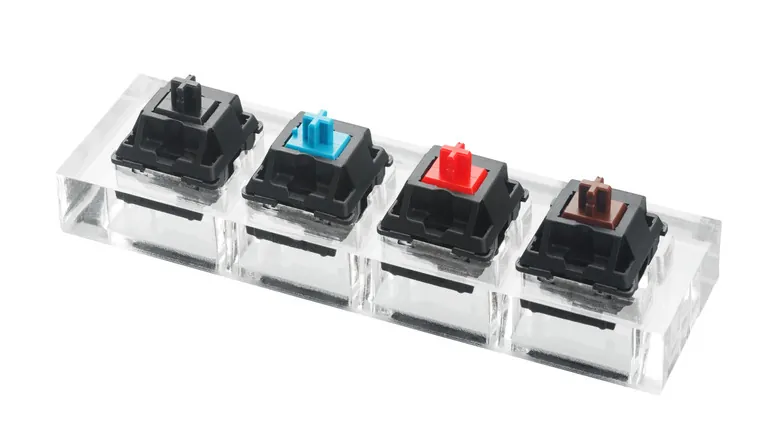
Different Types of The Mechanical Keyboard Switch
Today, switch selection focuses more on the actual needs of different users. Whether for esports competitions, word processing, programming, or daily office work, users can find a mechanical keyboard switch that best suits their usage habits.
Improved Durability and Manufacturing Precision
Continuous advancements in manufacturing processes are a key driving force behind the rapid development of modern mechanical keyboard switches. Early mechanical switches, due to limited manufacturing precision, were prone to issues such as inconsistent actuation force and varying smoothness between different switches. With the development of high-precision mold manufacturing, automated assembly, and quality inspection technologies, the consistency of mechanical keyboard switches has significantly improved.
Simultaneously, material technology has also been continuously optimized. Superior raw materials allow switches to maintain stable key feedback even after prolonged use. The widespread application of automated production lines has further reduced performance differences between products and improved consistency in mass production. Today, high-quality mechanical keyboard switches boast a mechanical lifespan of hundreds of millions of keystrokes, meeting the high-frequency usage needs of esports, office work, and professional creative work, providing users with a more stable and reliable input experience.
Hot-Swappable Design Expands User Flexibility
In recent years, hot-swappable design has become a significant trend in mechanical keyboard development. Hot-swappable technology, through dedicated switch mounts, allows users to replace switches without soldering, greatly reducing the difficulty of replacement. This design not only allows users to experience different switches according to their needs, but also drives the development of the custom keyboard market.
More and more keyboard enthusiasts are starting to experiment with different brands, different actuation forces, and different sound performances of switches to create an input experience that better suits their personal preferences. For keyboard switch manufacturers, the widespread adoption of hot-swappable technology has also promoted compatibility between switch products, expanded the scope of product applications, and further enriched the entire mechanical keyboard ecosystem.
Mechanical Keyboard Switch vs Other Technologies
Mechanical Keyboard Switch Remains the Mainstream Choice
Despite the emergence of new keyboard switch technologies in recent years, mechanical keyboard switches maintain a high market share, used in office keyboards, gaming keyboards, and custom keyboards. After decades of development, the entire mechanical keyboard switch industry chain, from switch structure and material selection to manufacturing processes, has reached a high level of maturity, consistently providing a stable input experience.
Meanwhile, different types of switches can meet diverse usage needs. Users can choose based on factors such as operating force, tactile feedback, sound performance, and application scenarios, making mechanical keyboard switches one of the mainstream solutions in the market.
Emerging Technologies Drive Industry Innovation
In recent years, with the gradual entry of new keyboard switches such as Magnetic Keyboard Switches and Inductive Keyboard Switches into the market, the industry has gained more possibilities:
- Magnetic Keyboard Switches utilize changes in magnetic fields to detect key positions, enabling functions such as Adjustable Actuation and Rapid Trigger, attracting increasing attention in the gaming field.
- Inductive keyboard switches use electromagnetic induction for key detection, offering features such as non-contact triggering, high durability, and stable input. They are increasingly being used in some high-end keyboard products.
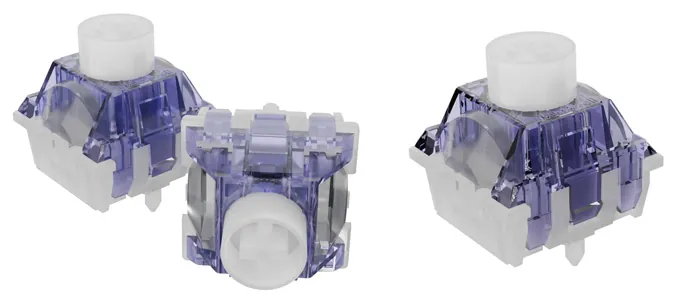
Magnetic Keyboard Switch
These new technologies provide richer solutions for different application needs. For users seeking adjustable triggering and high-speed response, new switch types offer new options. In the future, various keyboard switch technologies will develop and innovate in different markets, bringing users a more diverse input experience.
Conclusion
Mechanical keyboard switches have undergone decades of continuous development and innovation, from the typewriter era to the independent mechanical switches of computer keyboards, and now to the diverse switch technologies available. With continuous improvements in manufacturing processes, the emergence of new technologies, and increasingly diversified user needs, mechanical keyboard switches will continue to drive the development of future input devices in the keyboard industry.
For keyboard manufacturers, choosing a keyboard switch supplier with independent R&D capabilities, advanced manufacturing processes, and a rigorous quality management system not only ensures stable and reliable products but also helps brands create more competitive next-generation keyboard products.