
Blog
What Is a Magnetic Keyboard Switch and How Does It Work
In 1969, Honeywell filed and applied for patents related to magnetic switches, laying the foundation for the development of subsequent magnetic input structures. As the e-sports industry’s demands for input speed and accuracy continued to increase, the Hall Effect switch re-entered the mainstream and gradually evolved into the core technology of modern magnetic keyboard switches.
Compared to mechanical keyboard switches, magnetic keyboard switches detect signals through changes in magnetic fields, without relying on metal contact structures. Therefore, they excel in response speed, input accuracy, lifespan, and functional expansion, while also supporting advanced features such as Rapid Trigger, dynamic key travel, and SOCD. This article will systematically analyze the working principle, internal structure, and core advantages of magnetic keyboard switches to help you fully understand this next-generation input solution.
How Magnetic Keyboard Switch Works
How Hall Effect Technology Works in Magnetic Keyboard Switch
The core of the magnetic keyboard switch lies in Hall Effect magnetic induction technology, which operates through analog signal detection. When a user presses a key, the magnet inside the switch body shifts with the key travel, changing the magnetic field strength. A Hall sensor located above the PCB detects changes in the magnetic field in real time and converts them into continuous electrical signal data.
The system determines the specific position of the key based on changes in magnetic field strength, thereby achieving real-time key depth recognition, continuous position detection, dynamic trigger point determination, and more refined input feedback control, among other things. This mechanism gives the magnetic keyboard switch continuous control capabilities similar to “analog input,” better enabling special functions that were previously impossible with keyboards.
Magnetic Keyboard Switch vs Mechanical Keyboard Switch
Mechanical keyboard switches and magnetic keyboard switches differ fundamentally in structure and operating logic. Mechanical keyboard switches rely on the closure of metal contacts to conduct signals, and these contacts wear down over time. Furthermore, their trigger travel is fixed and cannot be dynamically adjusted, potentially leading to contact jitter during high-speed continuous input when fingers are moving.
In contrast, magnetic keyboard switches use a magnet and a Hall sensor for signal detection, eliminating the need for physical contact structures. The trigger position can be dynamically adjusted by the system, ensuring a stable and continuous input signal. Because magnetic induction reduces physical contact, it offers higher overall input stability and consistency, and is therefore increasingly favored by modern keyboard manufacturers.
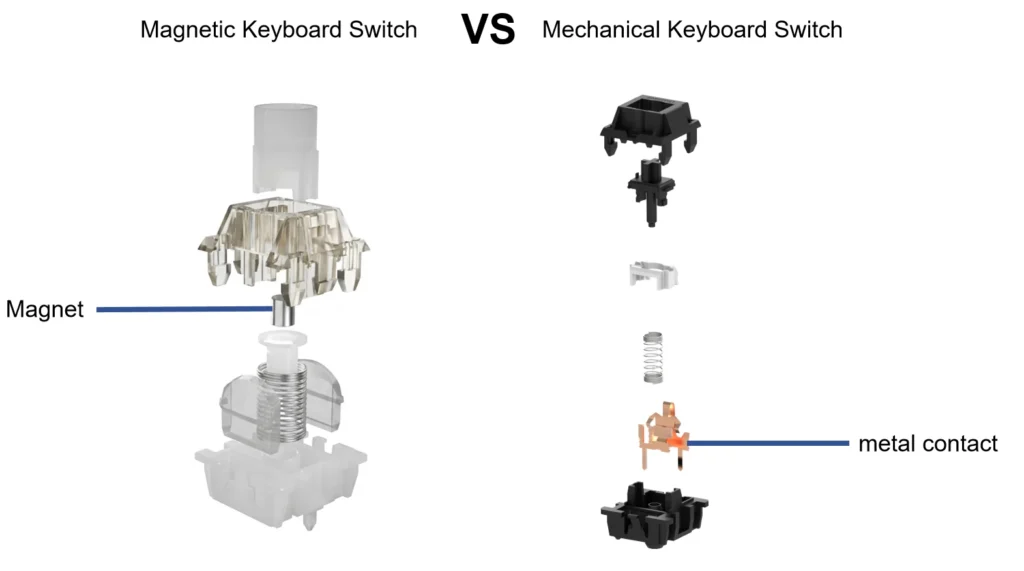
Internal Structure of Magnetic Keyboard Switch
Why is the N-52 high-grade magnet necessary?
In magnetic keyboard switches, high-quality manufacturers typically use N-52 high-grade magnets. These magnets have higher magnetic flux density and more stable magnetic field output, providing a stable magnetic field change curve, improving Hall sensor recognition accuracy, and reducing errors caused by external interference. Higher magnetic field stability results in stronger linear control of key actuation, which is especially important for e-sports input devices.
Split Stem Design Improves Magnetic Keyboard Switch Stability
The Split Stem Design is a key design optimization in polar magnetic keyboard switches. This structure achieves higher mechanical stability by separating the Stem into two parts: a “Fingertip contact area – movable module” and a “magnetic induction zone – floating module”.
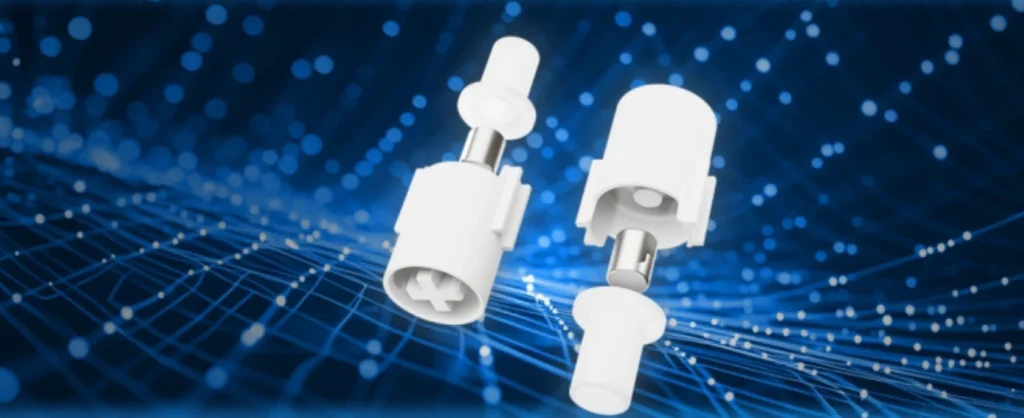
This structure reduces lateral movement of the key axis, improves the consistency of vertical key movement, greatly optimizes the stability of the typing feel during long-term input, and enhances positioning accuracy during high-speed operation. This significantly reduces accidental keystrokes and input deviations in high-frequency gaming input scenarios, making it widely used in high-end gaming keyboards.
Independent and Integrated Light Guide Structures
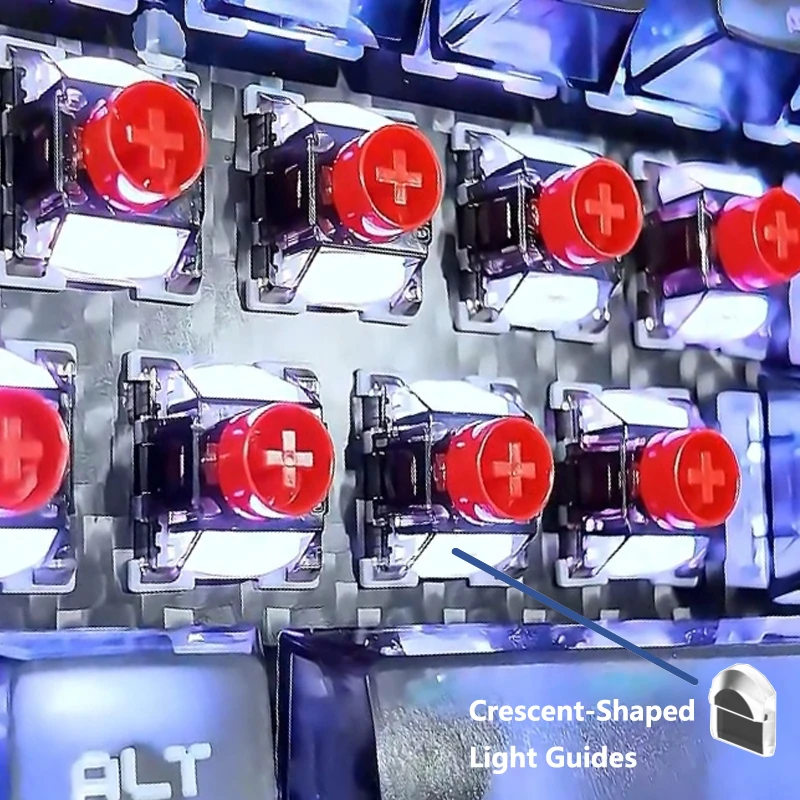
Magnetic keyboard switches feature light guide structures to optimize RGB lighting performance for more uniform and aesthetically pleasing lighting effects. Products on the market offer two types of designs: independent and integrated.
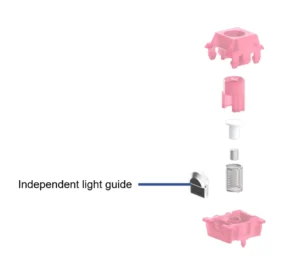
The independent structure involves inserting PMAA material light guides into the side of the magnetic keyboard switch, resulting in a clearer light propagation path, making it ideal for zoned RGB control.
The integrated light guide structure combines the top housing of the magnetic keyboard switch with the light guide column, making the structure more compact, the light uniformity higher, and more suitable for overall ambient lighting design.
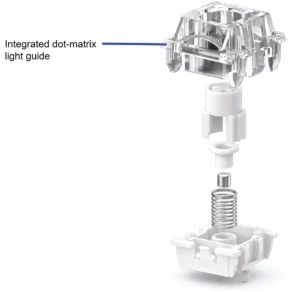
In magnetic keyboard switches, these two different light guide structures not only affect the visual effect but also the overall optical consistency of the keyboard, making it an important factor for users to consider when choosing a switch.
Key Advantages of Magnetic Keyboard Switch
Adjustable Actuation Creates Personalized Gaming Experience
A key advantage of magnetic keyboard switches is their adjustable actuation point. Users or systems can adjust the actuation depth, key sensitivity, and rapid release point according to different needs. This capability allows the same keyboard to adapt to different usage scenarios (such as high-precision input or high-speed rapid-fire), thereby improving the overall flexibility of the experience.
Rapid Trigger Is Changing Competitive Gaming
Rapid Trigger is one of the most representative features of magnetic keyboard switches. In the input logic of mechanical keyboard switches, keys must return to a fixed position to be re-triggered. Rapid Trigger, however, allows the system to instantly reset based on real-time position changes, without requiring the user to press a fixed actuation point.

Its core advantages include faster re-trigger speed, lower input latency, shorter bounce recognition path, and higher frequency of continuous operation. In scenarios requiring rapid switching of input states, this mechanism can significantly improve operational efficiency and even help players achieve victory in battle.
SOCD Functions Improve Input Precision
SOCD (Simultaneous Opposite Cardinal Direction) is mainly used to optimize directional conflict input logic. When a user simultaneously inputs signals in opposite directions, the system processes them according to preset rules, thereby avoiding conflicting inputs. It can improve the stability of directional control, reduce erroneous inputs, and optimize the control logic for high-speed movement, which is of great significance in high-intensity operating environments.
Longer Lifespan and Better Durability
Because magnetic keyboard switches do not rely on metal contacts for conduction, their mechanical wear is significantly reduced. Therefore, they typically have a lifespan of hundreds of millions of cycles, stable long-term input performance, and no contact oxidation or fatigue issues, giving them a significant advantage in long-term reliability.
Why Gaming Keyboard Manufacturers Are Accelerating Magnetic Keyboard Switch Adoption
Esports Market Is Driving Magnetic Keyboard Switch Demand
As the esports industry continues to expand, the demands on input devices are constantly increasing. Requirements such as lower latency, faster response times, more stable input consistency, and stronger functional expansion capabilities are driving the growth of magnetic keyboard switches in the high-end gaming keyboard market.
RGB Lighting Trends Increase Demand for Advanced Switch Structures
As some gamers increasingly demand higher visual experiences, RGB lighting effects have become an important part of keyboard design. Magnetic keyboard switches, through their light guide structures, can achieve more uniform light distribution, higher brightness output, and a stronger sense of visual depth, thus their application in high-end peripheral design is becoming increasingly widespread.
FAQ
Q1. Why is there no noticeable “tactile feedback” when pressing keys with the magnetic keyboard switch?
A1. Because it detects position through changes in the magnetic field, without any metal contact points, the feedback is smoother and more continuous.
Q2. Can you give an example of how the SOCD function works?
A2. If you set the last input priority rule, when you first press and hold the A key to move left, and then briefly press the D key to try to move right, the system will take the “pressing the D key” as the priority signal, causing your character to move right first.
Q3. What is the effect of the light guide design on the keyboard user experience?
A3. It mainly improves the uniformity of RGB lighting, making the keyboard visually more consistent and clearer.
Q4. Which types of games does the magnetic keyboard switch provide the greatest improvement?
A4. Mainly fast-paced real-time games like FPS and MOBA, and some SLG or tower defense games that require a lot of clicking.
Q5. What is hot-swapping, and what is its function?
A5. Hot-swappable keyboards refer to a technology that allows keyboard switches to be plugged in and unplugged directly while powered on, without the need for soldering. Its advantages include unparalleled customization and great convenience.
Conclusion
With the continued development of the e-sports industry, high-performance gaming keyboards, and smart input devices, magnetic keyboard switches are becoming an important direction for next-generation keyboard technology. Compared to mechanical keyboard switches, they have significant advantages in response speed, input accuracy, dynamic control capabilities, and long-term stability.
With the increasing popularity of features such as Rapid Trigger, SOCD, and dynamic key travel, the application scenarios for magnetic keyboard switches continue to expand. For gaming keyboard manufacturers, choosing high-performance polar magnetic keyboard switches designed by reputable keyboard switch manufacturers will be a crucial factor in enhancing product competitiveness.