
Blog
Which Mechanical Keyboard Switch Is the Quietest for Office Use?
For office users, the excellent feel and typing efficiency of mechanical keyboards are certainly attractive, but excessive key noise can often disrupt colleagues’ work and even become a nuisance in meeting rooms and open-plan offices. Therefore, choosing a quiet mechanical keyboard switch has become a growing concern for office users.
However, not all mechanical keyboard switches sound the same; there are significant differences between different switch types. This article will analyze the noise performance of various common mechanical keyboard switches step by step to help you find a keyboard switch more suitable for office use.
Why Mechanical Keyboard Switch Noise Matters in Office Environments
How Mechanical Keyboard Switch Sound Affects Workplace Productivity
In open-plan offices, employees share the same workspace. When multiple people use mechanical keyboards simultaneously, the continuous typing sound creates background noise, which can affect the concentration of colleagues nearby.
For programmers, editors, accountants, and other professionals, who need to type continuously for several hours or even more than ten hours a day, a loud mechanical keyboard switch can not only disturb colleagues but also cause auditory fatigue for the user.
Furthermore, in meetings and shared work-spaces, keyboard noise can be amplified by microphones, causing adverse effects. Therefore, more and more companies are prioritizing the quiet operation of office equipment, and the choice of a mechanical keyboard switch has become a crucial factor.
What Creates Noise in a Mechanical Keyboard Switch
Many users believe that keyboard noise comes entirely from the switches themselves, but this is not actually the case. Mechanical keyboard noise primarily comes from the following aspects:
- First, the internal structural impact of the switches. Clicky switches have a dedicated sound-generating mechanism that produces a clear click sound when a key is pressed.
- Second, the sound of the keycap bottoming out. When a user presses a key to the bottom, there is an impact between the keycap and the mounting plate, creating a knocking sound.
- Third, the resonance of the keyboard casing. Some keyboards with larger cavities produce noticeable echoes or hollow sounds, further amplifying the overall sound.
- Finally, there is the rebound sound. When a key is released, the spring returning to its original position and the switch structure returning to its original position also produce some noise.
In conclusion, while the mechanical keyboard switch is not the only factor affecting sound, it is certainly a crucial point worth considering.
Mechanical Blue Switch — The Loudest Mechanical Keyboard Switch
Why Mechanical Blue Switch Produces a Distinct Click Sound
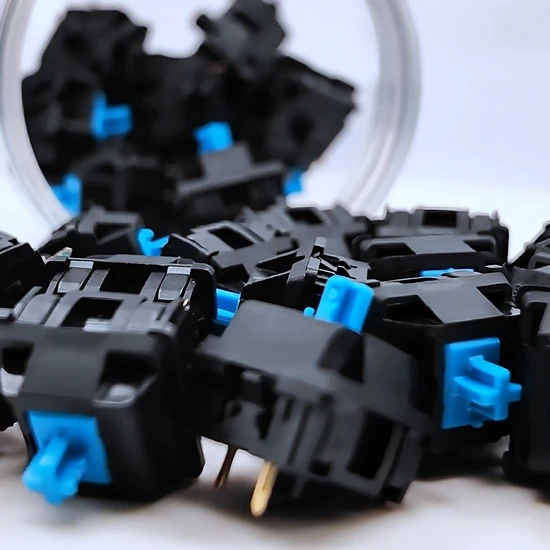
Among all mainstream mechanical keyboard switches, the Mechanical Blue Switch is usually the loudest. It uses a Click Jacket structure; when a user presses a key, the Click Jacket collides with internal components, producing a clear “click” sound. Simultaneously, the tactile feedback and sound feedback occur almost simultaneously, allowing the user to clearly perceive that the key has been actuated.
Advantages of Mechanical Blue Switch
Due to the click jacket structure, the Blue keyboard switch has a large and loyal user base, with extremely distinct tactile feedback. Users don’t need to press the key all the way down to perceive the actuation point.
Secondly, its input confirmation is very strong. Each actuation is accompanied by clear feedback, making it easy to establish a stable typing rhythm. For text editors, content creators, and some programmers, the Blue keyboard switch is very popular.
Why Mechanical Blue Switch Is Usually Not Recommended for Offices
However, for office environments, the Blue keyboard switch is too loud. The Click Jacket produces a continuous clicking sound as users type. This sound can easily travel to surrounding workstations, especially in open-plan offices.
This can create a consistently high-noise environment throughout the office. Therefore, unless you have a private office or the noise doesn’t bother others, a mechanical blue switch is not the best choice for an office environment.
Mechanical Brown Switch — A Balanced Mechanical Keyboard Switch Option
How Mechanical Brown Switch Reduces Noise
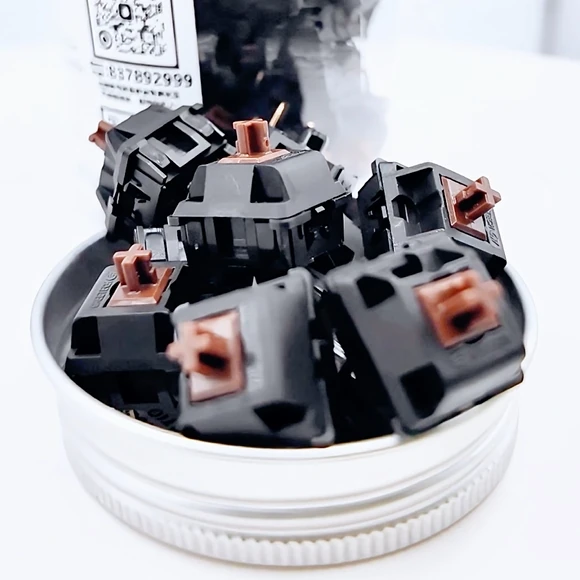
The Mechanical Brown Switch is a tactile switch. Compared to the Blue Keyboard Switch, it lacks a click mechanism, retaining only a slight tactile feedback. Therefore, it doesn’t produce a noticeable click sound when the keys are actuated.
While users can still feel the actuation point, the overall sound is significantly reduced. For this reason, the Brown Keyboard Switch has long been considered a balanced switch suitable for both office and entertainment use.
Mechanical Brown Switch for Office and Daily Use
For many office users, the Brown Keyboard Switch is a relatively reliable choice. It’s neither as completely linear as the Red Keyboard Switch nor as noticeably loud as the Blue Keyboard Switch.
The slight tactile feedback helps users confirm key actuation, reducing missed presses. Meanwhile, its noise level is generally acceptable in most office environments, making it a common feature in many corporate office keyboards.
Advantages and Limitations of Mechanical Brown Switch
The main advantage of the Brown Keyboard Switch is its balance. It strikes a good balance between tactile feedback and relatively quiet sound, making it suitable for a mix of gaming, office work, and everyday entertainment.
However, it’s important to note that the brown keyboard switch isn’t the quietest mechanical keyboard switch. Because it still has an internal tactile feedback mechanism, it still produces some sound during actuation, making it less silent than linear switches.
Mechanical Black Switch — A Quiet Mechanical Keyboard Switch for Heavy Typists
Why Mechanical Black Switch Is Quieter Than Tactile and Clicky Switches
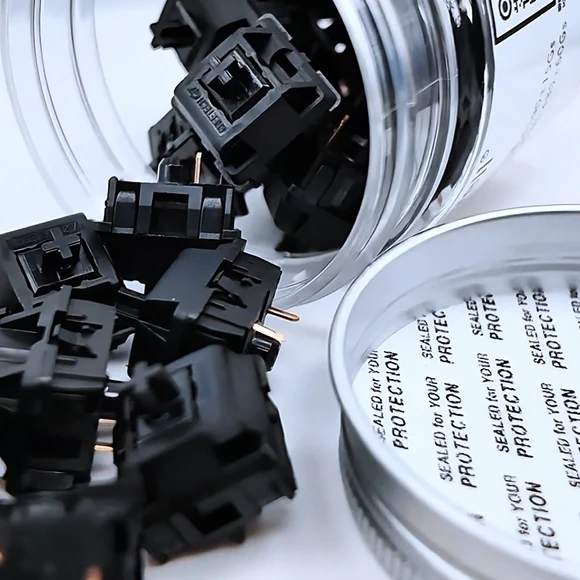
As a linear switch, the mechanical black switch has a very simple internal structure, lacking tactile and click mechanisms, thus producing no additional mechanical noise. Its entire pressing process remains linear and smooth, with the sound primarily coming from the keycap bottoming out and rebounding. It is quieter than brown and blue keyboard switches.
How Higher Actuation Force Affects Sound
The biggest feature of the black keyboard switch is its higher actuation force, effectively reducing accidental keystrokes, making it popular with some professional users and heavy-handed gamers.
However, precisely because it requires greater actuation force, some users may strike the keyboard with more force when typing at high speeds, resulting in a more noticeable bottoming-out sound. Therefore, while the black keyboard switch is structurally quiet, its final sound performance is still affected by the user’s typing habits.
Who Should Choose Mechanical Black Switch?
The black keyboard switch is more suitable for people who are used to heavy-handed typing, professional users who want to reduce accidental keystrokes, and writers who need a stable typing experience. For these users, the black keyboard switch offers a balance between quiet operation and a sense of control.
Mechanical Red Switch — The Most Popular Quiet Mechanical Keyboard Switch
Why Mechanical Red Switch Is One of the Quietest Mechanical Keyboard Switch Types
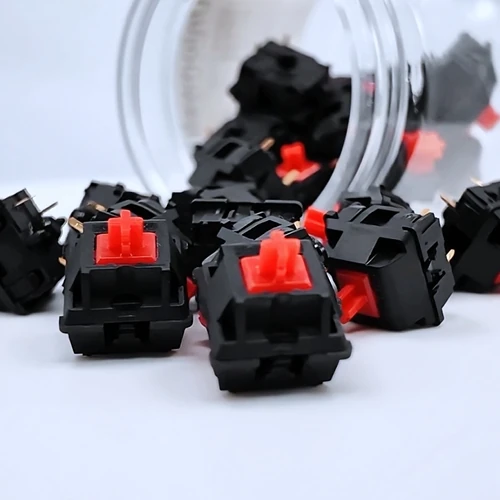
Among mainstream mechanical switches, the mechanical red switch is the quietest choice. It’s also a linear switch, with no tactile feedback, no click mechanism, and requires minimal actuation force. The entire pressing process is smooth and fluid, with users experiencing almost no additional resistance. Due to reduced internal structural impact, it naturally possesses excellent quietness.
Mechanical Red Switch Sound Characteristics
The sound of the Red Switch primarily comes from the keycap bottoming out and key rebound. Because there are no additional sound-producing structures internally, the overall sound is relatively pure and mellow. With a high-quality keyboard structure, switch lubrication process, and noise reduction design, its sound can be further reduced. Therefore, it is one of the most popular switches in the modern office keyboard market.
Why Office Users Prefer Mechanical Red Switch
Office users choose the Red Switch for clear reasons: lighter pressing force, making long typing sessions easier; less finger fatigue during continuous typing; and quiet operation, unlikely to disturb colleagues. For users who need to handle a large number of documents, emails, and code inputs every day, the Red Keyboard Switch often provides a more comfortable office experience.
Click to view keyboard switch sound
What Else Affects Mechanical Keyboard Switch Noise
Keycap Material and Mechanical Keyboard Switch Sound
Many users overlook the impact of keycaps on sound. Even with the same mechanical keyboard switch, different keycap combinations can result in different sound characteristics. PBT keycaps are typically thicker, producing a more solid sound. ABS keycaps, on the other hand, are relatively thinner, potentially resulting in a crisper sound.
Furthermore, the resonance effect produced by keycaps of different thicknesses also varies, which is another important factor contributing to the differences in mechanical keyboard sound.
Keyboard Housing Structure Matters
The keyboard housing structure also affects noise. Plastic housings generally have better sound absorption, while metal housings may enhance sound propagation. Additionally, the presence of sound-absorbing cotton, silicone pads, and cushioning materials inside significantly affects cavity sound and resonance performance. Therefore, an excellent silent keyboard design often requires a combination of switch design and structural improvements.
Lubrication and Silent Design Improvements
In recent years, more and more keyboard switch manufacturers have begun to focus on silent technology. The lubrication process reduces internal friction noise, sound-dampening pads reduce bottoming-out impact noise, and some silent switches even have added cushioning materials inside their structure, further reducing key noise. These technological advancements are continuously improving the quietness of office keyboards.
Which Mechanical Keyboard Switch Is the Quietest for Office Use?
Best Mechanical Keyboard Switch for Different Office Users
For purely office use, the Red Keyboard Switch is usually the best choice.
- If you want a balance between office work and light gaming, the Brown Keyboard Switch is more suitable.
- If you are a heavy-handed typist and want to reduce accidental keystrokes, the Black Keyboard Switch is more suitable.
- If you have a private office and prefer strong feedback, you can consider the Blue Keyboard Switch.
There Is No Single Best Mechanical Keyboard Switch
While many users are looking for the “best” mechanical keyboard switch, there is no single answer. Everyone’s tactile preferences, work environment, typing intensity, and budget are different. Therefore, the keyboard switch that best suits your individual needs is the truly best choice.
Future Trends of Quiet Mechanical Keyboard Switch
Silent Magnetic Keyboard Switch Designs Continue Evolving
With the continuous development of the e-sports and office markets, silent technology has become an important direction for the keyboard switch industry. In recent years, more and more manufacturers have begun to launch silent linear magnetic switch products. Compared with mechanical switches, magnetic keyboard switches reduce friction and impact noise through optimized structural design.
In the future, users will not only be able to obtain faster response speeds, but also enjoy a quieter and more comfortable typing experience. For office users, quietness, long lifespan, and high stability will become important development trends for the next generation of keyboard switches.
Conclusion
For office users, choosing a quiet mechanical keyboard switch is often more important than pursuing ultimate feedback. Considering sound performance, comfort, and long-term office experience, the red keyboard switch is generally considered the most suitable and quietest mechanical keyboard switch for office use.
With the continuous development of silent technology, the new generation of low-noise mechanical keyboard switches developed by professional keyboard switch manufacturers, as well as more advanced magnetic keyboard switches, will continue to drive the upgrade of the office input experience, creating a more efficient, comfortable, and focused working environment for users.