
Blog
How Do the Materials of the Housing and Stem Affect Keyboard Switches?
When selecting a keyboard, many people focus on spring weight or actuation type while overlooking the materials involved. What impact do differences in the materials used for the top housing, bottom housing, and stem actually have? In reality, a keyboard switch’s feel, sound, light transmission, and durability are all influenced by its materials. The “thock” and “clack” sounds often discussed by enthusiasts are essentially the results of these material differences.
Currently, POM, PC, and PA66 are the most common materials used for keyboard switch housings and stems; each offers distinct characteristics regarding friction, sound, and light transmission. This article provides an in-depth look at these materials—covering their properties, their impact on feel, sound, and optics, and the differences between mechanical and magnetic switches—to help you gain a better understanding.
Why Do Housing and Stem Materials Matter in a Keyboard Switch?
A complete keyboard switch typically consists of a top housing, bottom housing, stem, spring, and metal contacts (or a magnet). The top and bottom housings form the guide rails for the stem’s movement and the internal acoustic chamber, while the stem is the moving part that slides directly. Because these components act as structures for sound conduction and resonance, their materials determine friction, sound characteristics, light transmission, and long-term stability.
Specifically, the impact of materials can be categorized into several dimensions:
- Feel: Smoothness and the level of friction;
- Sound: The tonal profile, such as “thock” versus “clack”;
- Optics: Light transmission rate and the uniformity of lighting effects;
- Durability: Moisture absorption and compatibility with lubricants.
In summary, even with the same structural design, changing the materials can result in a vastly different typing experience.
The Three Core Materials for Keyboard Switch Housings and Stems
The three most common materials currently used for the top housing, bottom housing, and stem of keyboard switches are POM, PC, and PA66. Understanding the inherent properties of each material is the foundation for grasping the conclusions that follow.
POM: Self-Lubricating Smoothness and a Deep, Thocky Sound
POM (Polyoxymethylene) has an extremely low coefficient of friction and possesses natural self-lubricating properties on its surface. When used to manufacture top housings, bottom housings, and stems, friction between moving parts is minimal; the typing feel becomes increasingly smooth with use—a phenomenon enthusiasts often describe as “getting smoother the more you use it.”
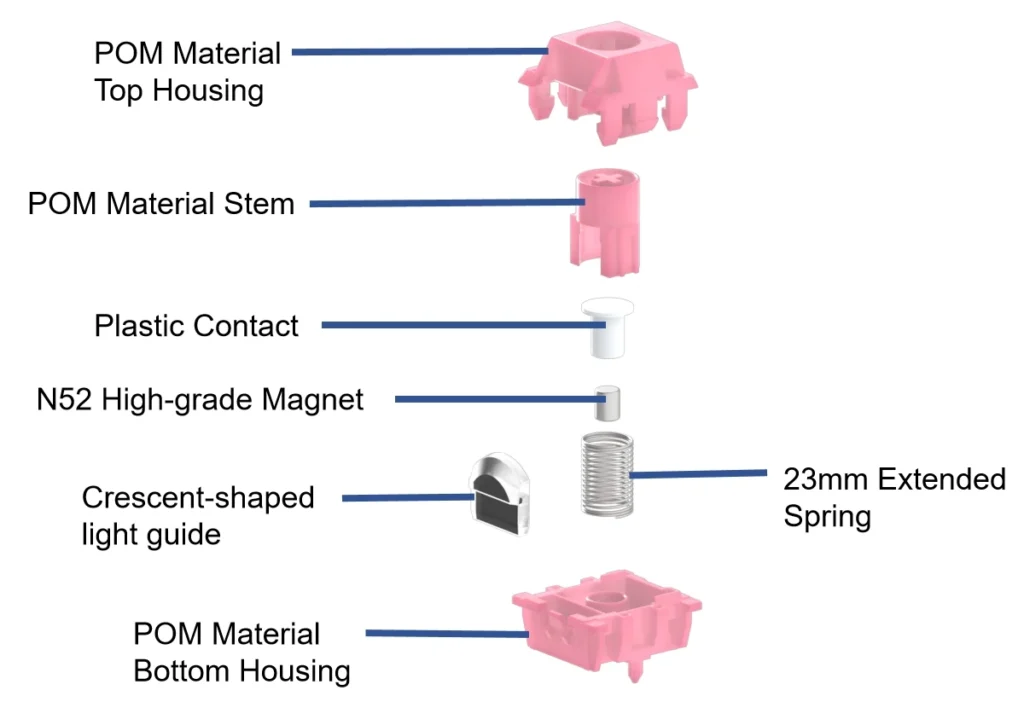
POM magnetic keyboard switch
In terms of sound, POM tends to produce a deep, solid “thock” sound and effectively absorbs high-frequency noise. However, its light transmission is relatively poor; traditional POM is typically milky white or opaque, and even translucent POM variants offer far lower light transmission than PC. Consequently, POM is frequently used for the top housings, bottom housings, or stems of magnetic switches—such as the “Polar Magnetic Blazing Bloom” switch, which features an all-POM construction.
PC: High Light Transmission and a Crisp, Clacky Sound
The core advantage of PC (Polycarbonate) is its high light transmission. It boasts exceptional transparency and optical purity, allowing it to diffuse light perfectly for even distribution, making it the material of choice for semi-transparent or fully transparent RGB keyboard switches.
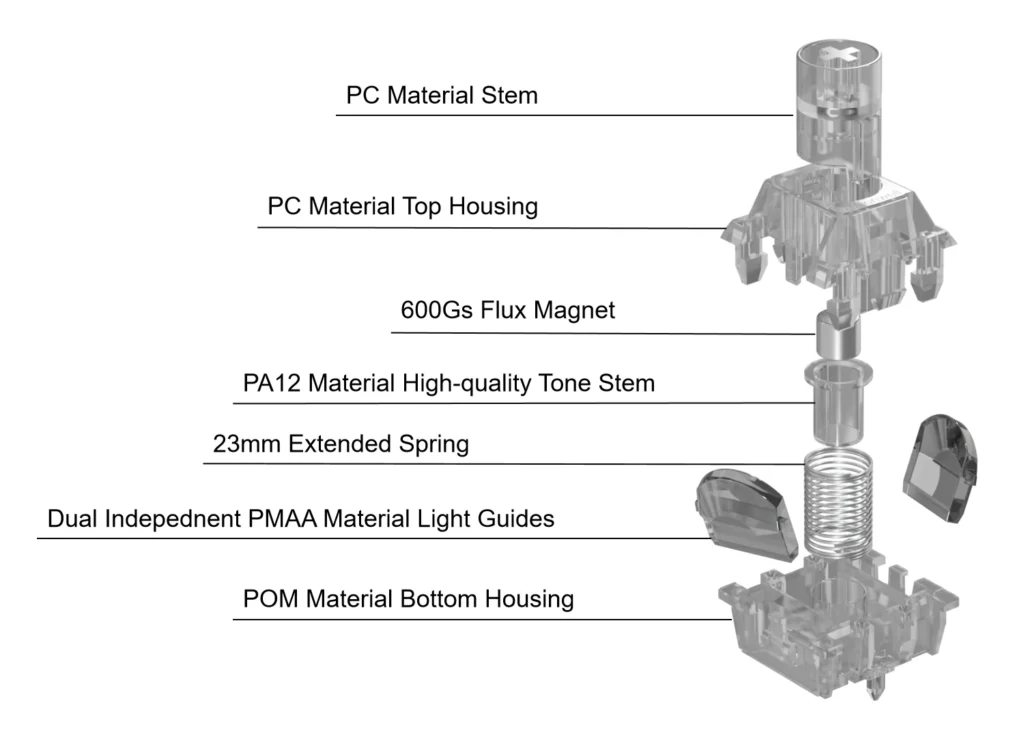
transparent keyboard switch
Regarding sound, PC is highly rigid, producing a crisper, more focused typing sound than POM (often described as a “clack”) with more pronounced resonance. In terms of feel, PC offers a dry sensation but has a slightly higher coefficient of friction than POM, resulting in a hint of scratchiness during initial use. Physically, PC is extremely tough and impact-resistant, though it is prone to scratching and carries a risk of stress cracking when exposed to certain grease-based lubricants. It is commonly used for the top housings, bottom housings, and stems of fully transparent switches, such as the “Polar Magnetic EVO Keyboard Switch“.
PA66 – The Classic Bottom Housing for a Round, Warm Typing Feel
PA66 (Polyamide 66) is the quintessential bottom housing material, regarded as an “OEM classic.” It delivers exceptional acoustic performance, producing a deep, rich, and non-harsh typing sound that is highly prized by enthusiasts of vintage aesthetics and sound quality.
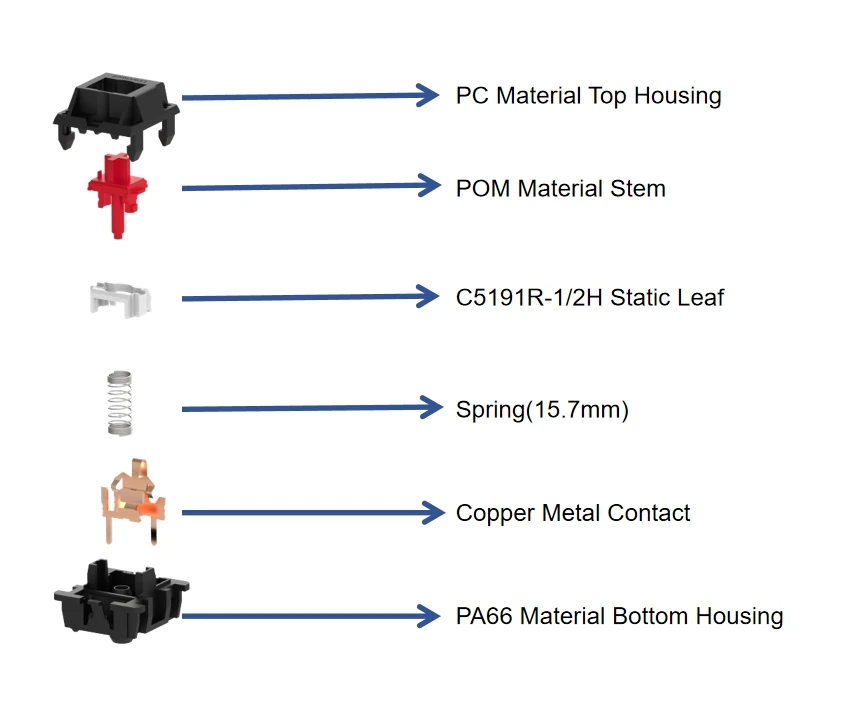
mechanical red keyboard switch
Regarding feel and break-in, nylon is relatively soft yet tough; the stem becomes exceptionally smooth as it wears in against the nylon rails over time. PA66 is opaque—typically black or available in custom colors—and while it has a slightly higher moisture absorption rate than POM, it remains highly stable in standard mechanical keyboard environments, offering excellent heat and wear resistance. It is commonly found in mechanical switches, such as the mechanical red keyboard switch.
How Do Materials Affect the Feel, Sound, and Light of a Keyboard Switch?
By examining the materials of the top housing, bottom housing, and stem together, we can systematically categorize their impact on feel, sound, and optics. Material selection is essentially about balancing smoothness, sound profile, and lighting requirements, rather than simply chasing a single “best” material.
Smoothness and Break-in Behavior
In terms of feel, POM has the lowest coefficient of friction, making it the smoothest option—and one that becomes even smoother with use. PC offers a crisp, dry feel but has slightly higher friction, which may result in a bit of scratchiness before lubrication. PA66 is relatively soft yet tough; stems made of this material become very smooth after breaking in against the nylon rails. Additionally, factory pre-lubrication can further reduce friction and enhance smoothness, though the lubricant must be compatible with the material to improve the feel without damaging the switch.
Sound Signature: Thock vs. Clack
Regarding sound, the typing noise is determined by material rigidity, the internal acoustic chamber, and the impact of the stem. POM produces a deep, solid sound that absorbs high-frequency noise, leaning towards a “thock” profile. PC yields a crisp, focused sound with distinct resonance, leaning towards a “clack.” PA66 offers a deep, rich, and mellow tone that is pleasant to the ear. Since the top and bottom housings form the acoustic chamber, combining different materials significantly alters the keyboard’s typing sound—which is why many enthusiasts “tune” the sound by swapping housings.
Light Transmission for Transparent Keyboard Switches
Optically, light transmission capabilities directly determine lighting performance. Transparent switches rely heavily on the high light transmission of PC to diffuse RGB lighting; a PC top housing paired with a dedicated light guide yields uniform, bright illumination. In contrast, POM and PA66 are opaque, making full transparency difficult to achieve. Therefore, if you are interested in transparent switches or keyboards, it is recommended to choose products with PC top and bottom housings to ensure superior light transmission and uniform illumination.
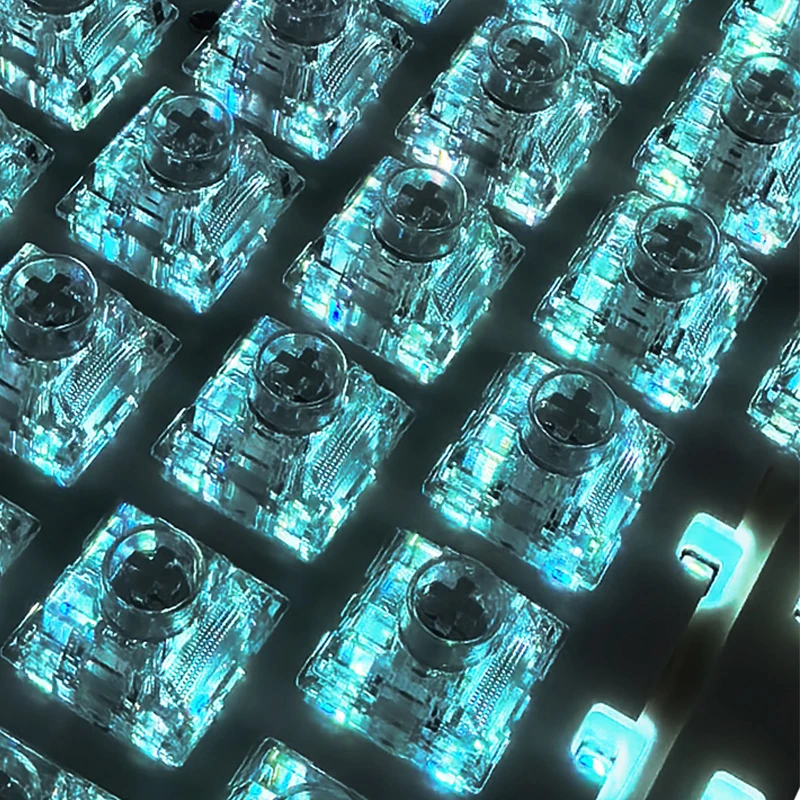
full-transparent keyboard lighting effect
How Do Materials Differ Between Mechanical and Magnetic Keyboard Switches?
Differences in actuation mechanisms dictate different priorities regarding material selection. Mechanical keyboard switches rely on the physical making and breaking of gold-alloy contacts; the contact material and plating directly influence contact resistance and electrical lifespan. Consequently, these switches often utilize a combination of a POM stem, PC top housing, and PA66 bottom housing to strike a balance between sound, smoothness, and durability.
In contrast, magnetic keyboard switches detect changes in magnetic flux via Hall-effect sensors. Since there is no physical contact wear, they can theoretically achieve a longer lifespan. Here, the smoothness of the stem material and the consistency of magnetic flux are paramount; configurations using all-POM, all-PC, or a combination of POM and PC are common.
In other words, the value of a specific material differs depending on the switch type: in magnetic switches, materials primarily serve to ensure friction-less smoothness and optimal lighting effects; in mechanical switches, materials must also work in tandem with contacts and springs to guarantee stability during frequent, long-term actuation.
What Else Do Housing and Stem Materials Influence?
Beyond typing feel, sound, and optical properties, materials also affect durability, moisture absorption, and lubricant compatibility. These factors become apparent over the course of frequent, long-term use and are often more significant than the initial feel upon unboxing.
Wear Resistance, Moisture Absorption, and Long-Term Stability
POM is wear-resistant and self-lubricating, making it ideal for stems subject to frequent sliding motion. PA66 has a slightly higher moisture absorption rate than POM but maintains stable dimensions and performance at room temperature, while offering excellent heat and wear resistance. PC offers high impact resistance and rigidity but is prone to surface scratches, requiring care during assembly and use. Long-term stability is not determined by a single material alone, but rather by the interplay of materials, lubrication, and manufacturing precision.
Lubricant Compatibility and Stress Cracking
PC carries a risk of stress cracking when exposed to certain ester-based lubricants; compatibility must be verified during lubricant selection to avoid potential damage to the switch housing. In contrast, POM exhibits good compatibility with most common lubricants. While factory pre-lubrication reduces friction and enhances smoothness, the lubricant must be matched to the specific material through testing. This underscores the fact that material selection is never an isolated decision; it must be considered in conjunction with the lubrication strategy.
How to Choose Housing and Stem Materials for Your Keyboard Switch?
When selecting a product, it is advisable to first determine the actuation mechanism. Next, select the material combination based on preferences for feel and sound, the need for light transmission, and requirements regarding lifespan and environmental conditions. Finally, conduct a comprehensive evaluation using parameters such as operating force, total travel, lifespan, and contact or magnetic flux specifications.
Regardless of the combination chosen, however, it is recommended to select a keyboard switch manufacturer with in-house R&D, precision manufacturing, and comprehensive quality control capabilities to ensure consistency in materials and operational characteristics across production batches.
Conclusion
The materials used for the top housing, bottom housing, and stem collectively determine the feel, sound, light transmission, and durability of a keyboard switch. POM is prized for its low friction and deep “thock” sound; PC excels with high light transmission and a crisp “clack” sound; and PA66 is popular for its rich, pleasant typing feel and excellent wear resistance. Ultimately, material selection is about striking a balance between smoothness, sound profile, lighting effects, and long-term stability.
When selecting a switch, consider the actuation mechanism and intended use case, while weighing factors such as friction and smoothness, sound characteristics, light transmission needs, wear and moisture absorption properties, and lubricant compatibility. Only by precisely matching material combinations to product positioning—and partnering with a manufacturer capable of robust R&D and quality control—can you produce a keyboard switch that sounds great, performs well, and offers long-term stability.