
Blog
How Plate Mounted Stabilizers Improve Keyboard Typing Experience
In recent years, with the booming development of mechanical keyboards, more and more users have begun to pay attention to the input experience. Among these, long keys such as the spacebar, Shift, Enter, and Backspace are prone to problems like wobbling, uneven pressure, and noise if they lack stabilizer assistance, thus affecting the overall input experience.
To solve this problem, Plate Mounted Stabilizers were designed. They improve the stability of large key presses, making keystrokes smoother and more consistent. This article will introduce their working principle, their improvement to the keyboard input experience, and their differences from PCB Mounted Stabilizers, helping readers fully understand this important component.
Why Plate Mounted Stabilizers Are Important for Mechanical Keyboards
For mechanical keyboards, besides the keyboard switch, the input experience of long keys also affects the overall quality. Keys such as the spacebar, Shift, Enter, and Backspace are used frequently; if their action is unstable, even with excellent switch performance, it will affect the overall feel.
While standard character keys require only a single keyboard switch for stable pressing, longer keys like the spacebar and Shift key, due to their larger surface area, are prone to tilting and uneven force distribution when supported solely by the central switch. Pressing from different positions can lead to inconsistent feedback and rebound, affecting typing stability and comfort. Therefore, mechanical keyboards typically include stabilizers to ensure a smooth and consistent pressing experience for longer keys.
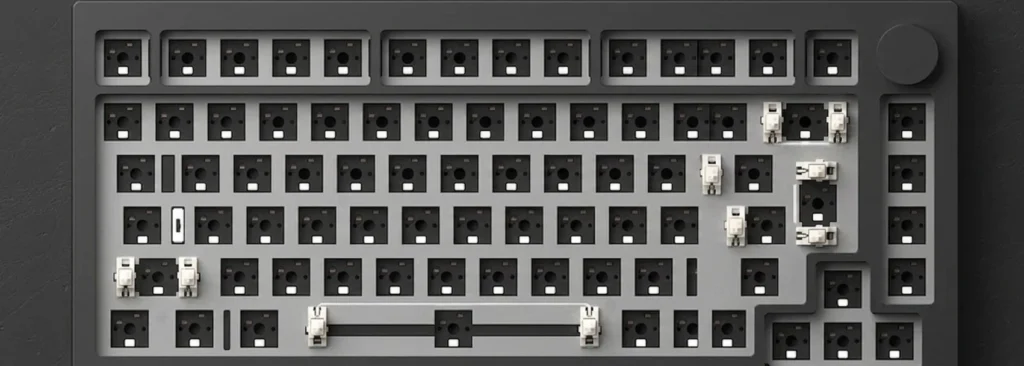
plate mounted stabilizer
Plate Mounted Stabilizers are designed to address this issue. Mounted on a plate and working in conjunction with the keyboard switch, they provide additional support for longer keys, maintaining balanced movement of the keycaps during pressing. Their main functions include: balancing force on both sides of the longer keys, resulting in more consistent feedback from different pressing positions; ensuring stable vertical movement of the keys and reducing lateral tilting; limiting lateral wobble of longer keys and improving overall structural stability; helping both sides maintain synchronized rebound for a more natural key return; and improving the overall typing experience, giving larger keys a more balanced and smooth feel.
If a mechanical keyboard lacks stabilizers, or if the stabilizer design and installation are improper, long keys are prone to issues such as sticking, inconsistent left and right key pressure, asynchronous rebound, and wire noise, affecting the typing experience. For users who frequently use keys like the spacebar, Shift, and Enter, these problems reduce typing efficiency and comfort.
Therefore, Plate Mounted Stabilizers have become an important component of the long key structure. Although they do not directly generate electrical signals or determine key actuation, they effectively improve the stability, consistency, and feel of long keys, making them a crucial mechanical component for improving the overall quality of a mechanical keyboard.
How Plate Mounted Stabilizers Work
How Plate Mounted Stabilizers Balance Key Movement
Plate mounted Stabilizers consist of a stabilizer housing, stem, wire, and plate mounting structure. The housing is fixed to the mounting plate, the stem connects to the keycap, and the wire connects the left and right stems. When the user presses a long key such as the spacebar, Shift, or Enter, the pressure is transmitted through the keycap to the stabilizer stem. The central keyboard switch is electrically triggered, and the wire synchronously drives the movement of both sides. Even if only one side of the keycap is pressed, the other side will be pressed down simultaneously, effectively preventing keycap tilting and uneven force distribution.

plate mounted stabilizer
Throughout the process, the plate mounted stabilizers do not participate in signal triggering; instead, they are responsible for maintaining a stable movement trajectory for long keys, reducing wobble, and ensuring that the keyboard switch always maintains force close to the keyboard switch, thereby improving keystroke consistency, input stability, and long-term performance.
Plate Mounted Stabilizers Improve Typing Consistency
The keyboard switch is always responsible for generating the electrical signals; Plate Mounted Stabilizers do not affect the keyboard switch’s triggering method. Because the left and right sides are synchronized, Plate Mounted Stabilizers significantly improve long-key performance. Whether pressing the spacebar, Shift, or Enter key from the left, middle, or right, a more consistent pressing feedback is obtained, reducing differences caused by uneven force.
At the same time, it also reduces long-key wobble and ensures synchronized rebound on both sides when the key is released, maintaining a smooth typing rhythm. This reduces changes in feel caused by different pressing positions, improving comfort for long typing sessions and rapid operations. In summary, although Plate Mounted Stabilizers do not participate in signal triggering, they are an important component for improving the stability of long keys and the overall typing experience of mechanical keyboards.
How Plate Mounted Stabilizers Improve Keyboard Typing Experience
Reduce Key Wobble During Typing
Large keys, due to their length, experience force differently than regular character keys. Without stabilizers, when pressing long keys, if the pressing position is off-center, the key is prone to tilting left or right, or even jamming.
Plate mounted stabilizers limit this unwanted free movement. When a user presses a long key, the two stabilizer stems move synchronously under the connection of a steel wire, keeping the entire keycap moving in a relatively stable vertical direction, without significant deviation due to different points of force application.
This stabilizing effect is mainly reflected in several aspects:
- Significantly reduced left-right wobble. When the user presses from the left, center, or right side of the keycap, the key still maintains a smooth movement, without one side sinking while the other stops.
- Effective control of lateral wobble in large keys. Excellent plate mounted stabilizers reduce the left-right looseness of the keycap, making the keycap more solid overall.
- More Consistent Key Pressing Trajectory. Stabilizers constrain the direction of keycap movement, ensuring each press follows the same trajectory, improving overall input consistency.
For users, reduced wobble not only improves feel but also helps reduce the probability of accidental keystrokes. When users rapidly press long keys, more stable keys provide clearer and more comfortable input feedback.
Provide More Even Key Presses
Plate mounted stabilizers not only reduce long key wobble but also achieve even pressure distribution. In actual use, users don’t necessarily press the exact center of the long key. Without stabilizers, different pressure points can easily cause keycap tilting, variations in resistance, and inconsistent rebound.
Plate mounted stabilizers connect the left and right ends with a wire, allowing for rapid transmission of pressure and synchronized movement. Regardless of where the key is pressed, it maintains stable pressure and rebound, reducing differences in feel due to varying pressure. This is especially important for programming, text editing, and office input.
Stable key feedback not only improves typing rhythm and operational comfort but also reduces fatigue from prolonged use. In summary, Plate Mounted Stabilizers, through this mechanical synchronization structure, provide a more balanced and stable long-key experience for mechanical keyboards.
Improve Keyboard Sound Quality
In recent years, more and more mechanical keyboard users have begun to pay attention to Keyboard Sound Profiles, understanding that large-key noise doesn’t necessarily originate from the keyboard switch, but may be generated by the Stabilizer structure. When there are gaps in the Stabilizer, problems such as wire impact, stem friction, asynchronous rebound, and keycap resonance may occur during pressing and rebound, resulting in a loose and uncoordinated long-key sound.
A well-designed and correctly installed Plate Mounted Stabilizers can effectively reduce wire wobble, improve left-right synchronization, reduce mechanical vibration, make the large-key sound more focused, and maintain a more consistent sound performance with ordinary character keys. Therefore, whether it’s a custom keyboard or a mass-produced mechanical keyboard, high-quality Plate Mounted Stabilizers help improve the overall typing experience and product consistency.
Plate Mounted Stabilizers vs. PCB Mounted Stabilizers
With the continuous development of mechanical keyboards, there are currently two main mounting solutions for stabilizers on the market: Plate Mounted Stabilizers and PCB Mounted Stabilizers. They differ only in their mounting method and are suitable for different types of mechanical keyboard designs. As a mechanical keyboard accessory, understanding the differences between them helps users choose the more suitable stabilizer solution based on their keyboard structure.
PCB Mounted Stabilizers Compared with Plate Mounted Stabilizers
The main difference between PCB-Mounted Stabilizers and Plate-Mounted Stabilizers lies in their mounting location and fixing method. Plate Mounted Stabilizers are fixed to a positioning plate (Plate), which provides support; while PCB Mounted Stabilizers are directly mounted on the PCB (Printed Circuit Board) and fixed in place with the circuit board.
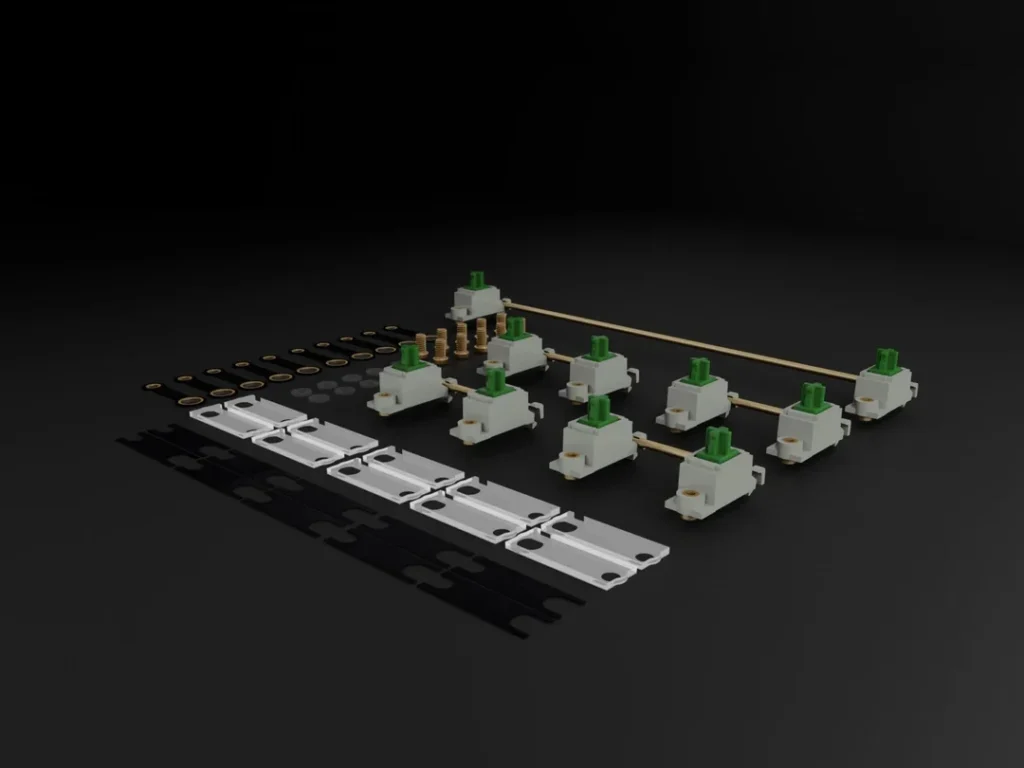
PCB mounted stabilizer
The two also differ in assembly methods, usage scenarios, and maintenance difficulty. Plate Mounted Stabilizers are simpler to install and have higher disassembly and assembly efficiency, making them suitable for mass-produced mechanical keyboards, and therefore widely used. Its advantages include easy installation, low maintenance costs, and strong compatibility.
In contrast, PCB Mounted Stabilizers require higher installation precision and are more commonly used in custom mechanical keyboard structures, providing users with different assembly options. Neither type of stabilizer is inherently superior; the actual choice depends on the keyboard structure, manufacturing process, and maintenance needs.
Conclusion
While Plate Mounted Stabilizers do not directly participate in key signal triggering, their importance to the overall input experience of a mechanical keyboard is no less than that of a keyboard switch. As the mechanical keyboard market continues to evolve, users are no longer solely focused on the keyboard switch produced by the keyboard switch manufacturer, but are increasingly concerned with the overall harmony of the key structure.
In the future, Plate Mounted Stabilizers will continue to be optimized to meet the ever-increasing demands of the office, gaming, and custom keyboard markets. For keyboard manufacturers, simultaneously improving the structural design, manufacturing precision, and quality control of Plate Mounted Stabilizers while selecting high-quality keyboard switches will help create more stable, comfortable, and competitive products.