
Blog
Magnetic Keyboard Switch vs Inductive Keyboard Switch: A Complete Comparison
In recent years, gaming keyboards have increasingly demanding requirements for actuation speed, precision, and adjustability. Magnetic keyboard switches have rapidly developed due to features such as adjustable actuation points, rapid triggers, and analog input. Meanwhile, inductive keyboard switches have also begun to enter the keyboard market, becoming another noteworthy non-contact sensing technology.
However, their underlying sensing mechanisms differ, resulting in differences in interference resistance, temperature stability, performance, reliability, cost, and market maturity. This article will compare Magnetic and Inductive Keyboard Switches in terms of working principles, performance, interference resistance, reliability, market availability, and practical selection to help you choose the appropriate technology.
What Is a Magnetic Keyboard Switch?
Magnetic keyboard switches detect key positions through magnetic induction. Currently, the Hall Effect solution is the most common in the market.
Its basic structure involves installing a magnet in the keyboard switch stem and configuring a magnetic sensor on the PCB. When the stem moves, the relative position of the magnet and sensor changes. The sensor detects the magnetic field variation, which is then converted into key position by the controller and firmware.
Therefore, the performance of a magnetic keyboard switch depends not only on the switch itself but also on the compatibility of the magnet, sensor, PCB, controller, and firmware.
How Does a Magnetic Keyboard Switch Work?
When a keycap is pressed, the stem moves the magnet towards the PCB sensor. As the distance changes, the strength of the magnetic field received by the sensor changes.
The controller samples and processes this signal to obtain continuous key positions. The firmware then sets the actuation point or reset point based on the position data. This is the foundation for the advanced functions of a magnetic keyboard switch, such as rapid triggering, adjustable actuation, and some analog input.
What Are the Main Advantages of Magnetic Keyboard Switches?
The biggest feature of a magnetic keyboard switch is its ability to perform continuous position detection. Users can adjust the actuation point via firmware and utilize Rapid Trigger for more flexible triggering and reset control. Meanwhile, non-contact sensing reduces issues such as contact wear, oxidation, and debounce found in mechanical keyboard switches.
Furthermore, due to the absence of contact friction, some magnetic keyboard switches boast a mechanical lifespan of up to 100,000,000 cycles, superior to most mechanical keyboard switches.
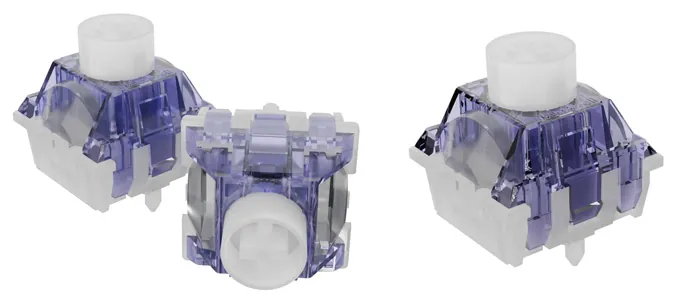
magnetic keyboard switch
What is an Inductive Keyboard Switch?
An inductive keyboard switch is also a type of non-contact keyboard switch, but its detection principle differs. It primarily utilizes the principles of electromagnetic induction, detecting key movement through an inductive sensing structure.
This type of keyboard switch uses an aluminum conductive rod that cuts magnetic field lines, engaging with an inductive coil on the PCB, instead of using a switch-mounted magnet. Therefore, both can obtain continuous key positions, but the signal generation mechanisms are different.
How Does an Inductive Keyboard Switch Detect Key Movement?
When a user presses a key, the stem moves the aluminum conductive rod. The change in the relative position of the conductive rod and the inductive coil alters the electromagnetic response of the sensing circuit. The PCB detects this change and converts it into a key position through signal processing. Because it doesn’t require mechanical contact, it can also achieve non-contact sensing.
Why Is an Inductive Keyboard Switch Considered a Newer Technology?
Compared to magnetic keyboard switches, inductive keyboard switches are still in an earlier stage of development in the keyboard market. Currently, there are relatively few related products, and third-party compatible solutions, the firmware ecosystem, and large-scale market validation are also relatively limited.
However, this does not mean that inductive technology lacks potential; it simply indicates that its supply chain, PCB design, firmware, mass production experience, and user validation still need further development.
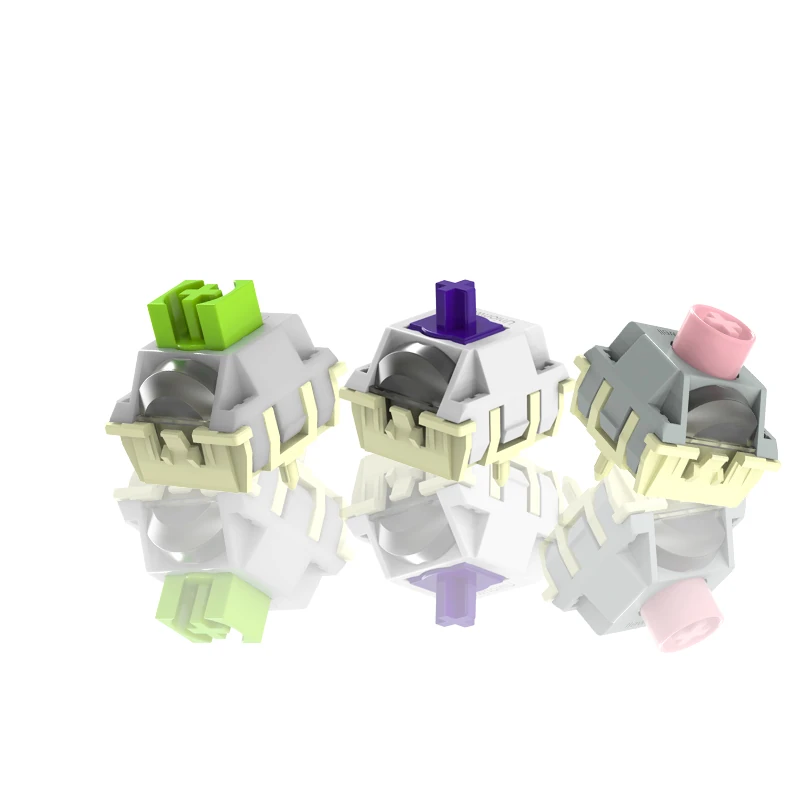
inductive keyboard switch
Magnetic Keyboard Switch vs Inductive Keyboard Switch: How Do They Work Differently?
Magnetic Sensing in Magnetic Keyboard Switch
In a magnetic keyboard switch, the magnet is usually installed inside the stem. When the stem moves, the distance between the magnet and the Hall sensor changes, and the sensor outputs a corresponding signal based on the magnetic field variation. Therefore, these products mainly operate through the Hall effect; the magnet position, sensor sensitivity, and the distance between them all affect the final signal.
Electromagnetic Sensing in Inductive Keyboard Switch
Inductive keyboard switches use an inductive sensing structure; stem movement changes the relative position of the aluminum conductive rod and the coil. This design operates via electromagnetic induction, eliminating the need for a switch-mounted magnet, thus differing from the magnetic induction path of a magnetic keyboard switch.
Does the Sensing Method Affect Keyboard Design?
The sensing method does influence keyboard design. Magnetic keyboard switches require consideration of hall sensor placement, magnet position, PCB layout, and sensor-to-switch alignment. Inductive keyboard switches, on the other hand, focus on coil geometry, conductive rod, PCB layout, and adjacent sensing circuits.
Both approaches require firmware calibration. Therefore, the switch, PCB, controller, and firmware should be designed as a complete system.
Magnetic Keyboard Switch vs Inductive Keyboard Switch: Which Has Better Interference Resistance?
Interference resistance is one of the key differences between the two technologies. Due to their different sensing mechanisms, they face different primary sources of interference.
How Can External Magnets Affect a Magnetic Keyboard Switch?
The position sensing of a Magnetic Keyboard Switch relies heavily on the magnetic field. Therefore, strong external magnetic field interference can alter the magnetic field around the sensor. For example, some mobile phones and magnetic accessories contain strong magnets. When these are near the keyboard, at certain distances and orientations, they will affect Hall sensor reading.
The actual degree of impact depends on magnet strength, distance, sensor sensitivity, and system calibration. Therefore, this is a potential interference factor that needs to be considered in the design of a Magnetic Keyboard Switch and requires in-depth research by the keyboard manufacturer.
Why Can Temperature Become a Consideration for Magnetic Keyboard Switch?
Temperature variations can also affect magnet characteristics, Hall sensor behavior, PCB electronics, and calibration. Insufficient temperature compensation can lead to sensor reading drift. Significant temperature rise and insufficient signal margin can also cause intermittent input, a problem that some magnetic keyboards urgently need to address.
Can Inductive Keyboard Switch Reduce These Interference Concerns?
Inductive keyboard switches can mitigate some of these risks. They lack the magnetic field relationship between the magnet and the Hall sensor. Therefore, external magnets such as those from the phone or magnetic accessories will not directly alter the position sensing signal in the same way. Furthermore, they do not exhibit magnet-based temperature behavior, and these keyboards consume less power, resulting in minimal temperature rise under normal circumstances.
However, inductive keyboard switches still need to consider electromagnetic interference, PCB layout, signal noise, and temperature compensation. Therefore, they are not “completely interference-resistant.” While they have potential advantages in terms of external magnet influence and some magnetic induction-related temperature issues, their final performance should still be verified through specific product testing.
Magnetic Keyboard Switch vs Inductive Keyboard Switch: Performance Comparison
Actuation Accuracy
The accuracy of a magnetic keyboard switch is related to magnet consistency, hall sensor, mounting location, and firmware calibration. Inductive keyboard switches are more affected by coil geometry, conductive rod, PCB tolerance, and signal processing.
Therefore, evaluation should focus on actual resolution, repeatability, and calibration stability, rather than simply comparing sensing technology.
Response Speed and Rapid Trigger
Both technologies can quickly obtain key position, thus providing the technological basis for implementing Rapid Trigger. However, keyboard latency is also affected by factors such as sensor sampling, scan rate, controller, firmware, and USB polling rate; the final response speed cannot be judged solely based on product type.

rapid tigger
Adjustable Actuation and Analog Input
Magnetic keyboard switches are well-established for adjustable actuation, Rapid Trigger, and analog input. While inductive keyboard switches can theoretically achieve similar functionality based on their sensing architecture, commercially available controllers, firmware, and calibration may not be compatible.
Magnetic Keyboard Switch vs. Inductive Keyboard Switch: Reliability and Durability
Mechanical Reliability of Magnetic Keyboard Switch
Although the sensing mechanism of a magnetic keyboard switch lacks mechanical contacts, the stem, spring, and housing are still in continuous motion. Therefore, stem wear, spring fatigue, housing tolerance, and assembly consistency need to be considered. Some products can achieve a mechanical lifespan of approximately 100 million cycles, but the actual lifespan should be based on the manufacturer’s specific products.
Reliability Considerations for Inductive Keyboard Switch
In addition to the mechanical structure, inductive keyboard switches also require attention to the inductive coil, signal stability, temperature behavior, and calibration consistency. Due to their relatively short market application time, long-term, large-scale reliability data is still accumulating. Long-term actuation, temperature cycling, signal stability, and batch consistency tests should be performed before purchase.
Magnetic Keyboard Switch vs Inductive Keyboard Switch: Market Availability and Cost
Why Are Magnetic Keyboard Switches More Widely Available?
The market ecosystem for Magnetic Keyboard Switches is relatively mature, with numerous Hall Effect switches, compatible PCBs, controllers, firmware, and keyboard software solutions available. Therefore, brands can choose different operating forces, travel, springs, and housing configurations, making development relatively easier.
Why Are Inductive Keyboard Switches Still Less Common?
The market for Inductive Keyboard Switches is not yet mature, with only a handful of related switch and keyboard products available. This is likely due to a combination of factors, including sensor technology, PCB design, firmware development, production experience, and supply chain scale. Therefore, product selection and compatibility solutions remain limited.
Are Inductive Keyboard Switches More Expensive?
Currently, some Inductive Keyboard Switch products are positioned at the high end, with limited product quantities and a limited supply chain scale, resulting in relatively high prices. However, this does not necessarily reflect long-term costs. As production scales up, suppliers increase, and the ecosystem matures, there is significant room for cost reduction. Therefore, procurement should comprehensively calculate unit cost, development cost, testing cost, and long-term supply cost.
Magnetic Keyboard Switch vs. Inductive Keyboard Switch: Which One Should You Choose?
Choosing the right technology depends on the target keyboard’s functionality, usage environment, and supply chain requirements.
When Should You Choose a Magnetic Keyboard Switch?
If your product requires a mature ecosystem, a wider selection of keyboard switch models, adjustable actuation, rapid triggering, and mature firmware support, a Magnetic Keyboard Switch is easier to implement. For gaming keyboards requiring rapid mass production and stable supply, it remains a more mature choice.
However, if the usage environment has a strong external magnetic field, interference testing should be performed beforehand to avoid keyboard malfunctions due to interference.
When Should You Consider an Inductive Keyboard Switch?
If you want to explore different sensing architectures or want to reduce specific magnetic interference concerns, consider an Inductive Keyboard Switch. Inductive Keyboard Switches are particularly advantageous for applications requiring reduced external magnet influence.
However, before purchasing, it’s crucial to verify product availability, PCB compatibility, firmware support, calibration, supplier capability, production consistency, and cost to avoid buying inferior products.
Conclusion
While both Magnetic Keyboard Switches and Inductive Keyboard Switches utilize non-contact keyboard sensing technology, Magnetic Keyboard Switches rely on the magnetic field variation of magnets and sensors, boasting a more mature product ecosystem. Inductive Keyboard Switches, on the other hand, detect electromagnetic changes through inductive sensing structures, and their market is still developing.
Therefore, a reasonable choice requires a comprehensive consideration of the different factors of both products, as well as their respective advantages and disadvantages. Only by selecting the appropriate keyboard switch manufacturer and corresponding product can you better configure your device. If you would like to learn more about these two products, you can refer to this shopping guide at https://www.unionwellkeyswitch.com/unionwell-keyboard-switch-buying-guide/ for more detailed parameters and features to help you choose your ideal product.