
Blog
Why Do Some Keyboard Switches Use Transparent Materials?
Many keyboards on the market today emphasize RGB back-lighting and gaming aesthetics, often utilizing transparent or semi-transparent materials in their switches. This design choice directly influences how LED light propagates within the switch, thereby affecting keycap brightness, light uniformity, and the overall RGB visual effect.
However, the market offers various types of switches—such as mechanical and magnetic switches—each operating on different principles. Consequently, the placement and function of transparent materials vary depending on the switch type. Understanding exactly where these transparent materials are used and why they are suitable for those locations provides valuable insight when selecting a switch.
What Is the Structure of a Mechanical Keyboard Switch?
Key Components of a Mechanical Keyboard Switch
A mechanical keyboard switch consists of several core components: the housing, stem, spring, and metal contacts.
- The housing secures internal parts and guides the movement of the stem;
- The stem directly receives the pressing force from the keycap and triggers the internal mechanism;
- The spring provides the restoring force that returns the stem to its initial position after the key is released;
- The metal contacts alter the circuit’s connection state as the stem moves.
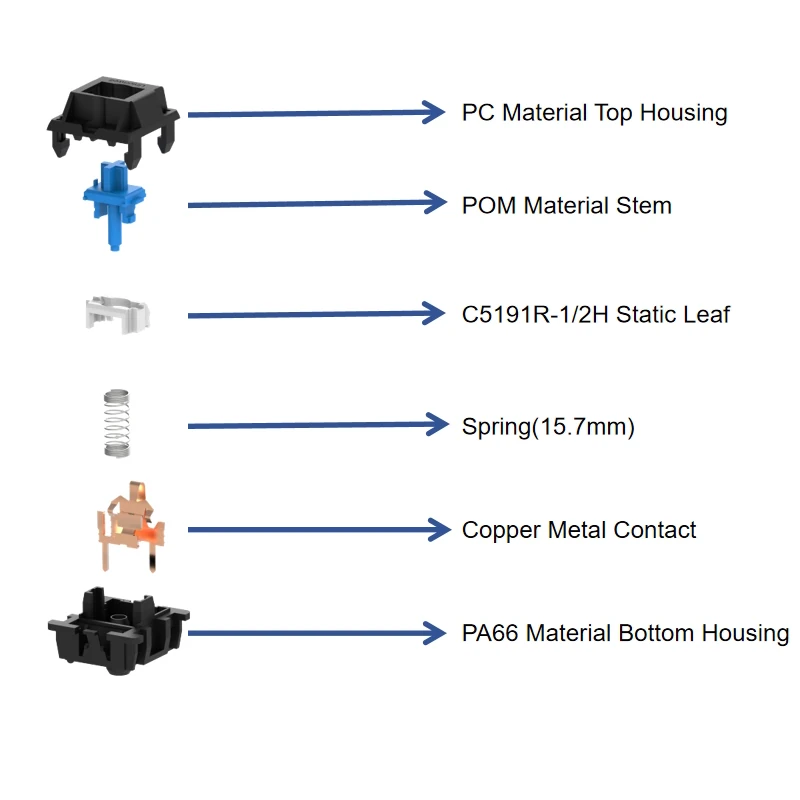
mechanical keyboard switch structure
Together, they form a mechanical input structure: the housing determines the positioning and range of motion for internal components, the stem transmits mechanical displacement, the spring facilitates the return movement, and the metal contacts execute the final electrical signal switching.
How Does a Mechanical Keyboard Switch Work?
When a user presses the keycap, force is transmitted through the stem into the switch. The stem moves downward along the housing’s guide structure, pushing the contact mechanism and shifting the position of the metal contacts, which alters the circuit state. The keyboard’s control circuitry detects this change and registers it as a keystroke input.
Upon releasing the key, the spring’s elastic force pushes the stem back to its original position, returning the contacts to their initial state. The entire process relies on precise mechanical displacement and contact switching; the core mechanism can be summarized as: Key Press → Stem Movement → Contact Switching → Electrical Signal.
What Is the Structure of a Magnetic Keyboard Switch?
There are significant differences between the internal structures of magnetic keyboard switches and mechanical keyboard switches. Their core input detection mechanism does not rely on physical contact between metal contacts; instead, it utilizes changes in the magnetic field to determine the position of the stem.
Key Components of a Magnetic Keyboard Switch
A magnetic keyboard switch primarily consists of a housing, stem, spring, magnet, and light guide. Unlike mechanical keyboard switches, it incorporates a magnet mounted on the stem or a related moving part.
How Does a Magnetic Keyboard Switch Detect Key Movement?
When a user presses a magnetic keyboard switch, the stem moves downward within the housing, shifting the magnet’s position. As the relative distance between the magnet and the sensing element changes, the magnetic field at the detection point fluctuates. The detection circuitry continuously monitors these magnetic field changes and converts them into positional data regarding the key’s travel.
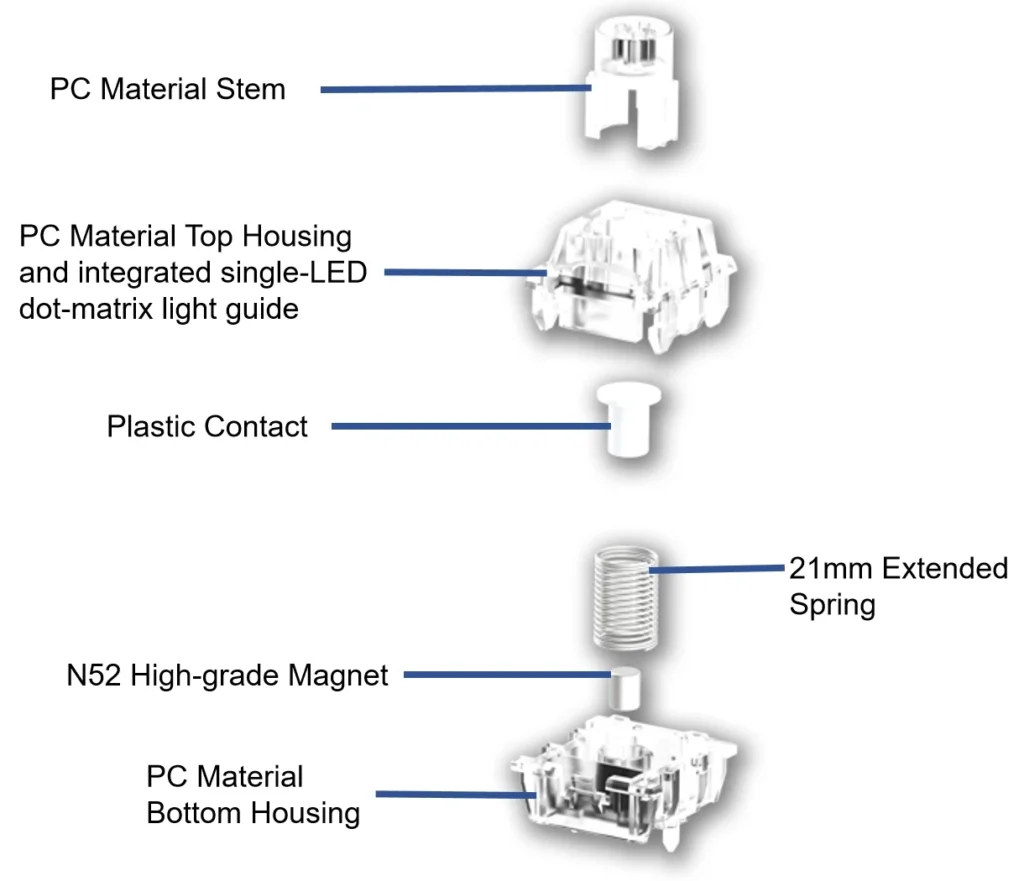
magnetic keyboard switch structure
The core process is: Key Press → Stem Movement → Magnet Position Change → Magnetic Field Change → Position Detection. Unlike mechanical keyboard switches, this detection mechanism does not rely on physical contact between metal points; instead, it captures input information by combining magnet position changes with an electronic detection system.
Which Keyboard Switch Components Can Use Transparent Materials?
Transparent materials are not suitable for every component of a keyboard switch. The decision to use transparent materials depends on the component’s location, its function, and the keyboard’s lighting architecture.
Transparent Housing for Keyboard Switches
The housing is a common component made from transparent materials in keyboard switches, typically utilizing engineering plastics like PC (polycarbonate) that offer a balance of light transmission and mechanical performance. A transparent or semi-transparent housing minimizes obstruction of the LED light, allowing more light to reach the keycap and enhancing the visibility of RGB lighting effects.
However, the housing also serves structural functions—securing, positioning, and guiding components—so the material must meet requirements for dimensional stability, mechanical strength, and injection molding precision. Excessive dimensional deviation could interfere with stem movement, switch assembly, and keycap installation. Consequently, keyboard switch manufacturers must balance optical performance with mechanical tolerances rather than prioritizing light transmission alone.
Transparent Stems in Magnetic Keyboard Switches
In magnetic keyboard switches, the stem can also be made from transparent or translucent materials. Positioned near the LED’s optical path, a transparent stem allows light from an LED mounted on the PCB to pass through its structure and into the keycap, thereby enhancing character back-lighting and RGB effects.

transparent keyboard switch
However, since the stem undergoes continuous vertical reciprocating motion, the material must possess—in addition to light transmission capabilities—excellent dimensional accuracy, wear resistance, and structural stability. Furthermore, factors such as material color, light transmittance, internal texture, and surface finish all influence light propagation. Consequently, the design of transparent stems requires a balance between mechanical and optical performance.
Transparent Light Guides in Magnetic Keyboard Switches
In magnetic keyboard switches, the light guide is a key component utilizing transparent materials; its primary function is to direct LED light along a designed path while minimizing light loss. Insufficient light transmission impedes light propagation, resulting in weakened RGB effects, reduced brightness, or uneven light distribution. At the same time, the component’s dimensions, positioning, and assembly method must align with the switch’s mechanical structure and sensing system to ensure structural stability while optimizing optical performance.
Why Do Some Keyboard Switches Use Transparent Materials?
The use of transparent materials in keyboard switches is essentially a matter of aligning material properties with product functionality. Beyond merely altering the visual aesthetics of the switch, these materials significantly influence LED light transmission efficiency and the visibility of the switch’s internal components.
Keyboard Switches for Better RGB Lighting
RGB lighting is a primary reason for the use of transparent materials in keyboard switches. LEDs are typically positioned on the PCB or beneath the switch, requiring light to pass through the switch’s internal structure to reach the keycap. Excessive obstruction by components such as the housing or stem can reduce light transmission efficiency. Utilizing transparent or translucent materials minimizes light blockage, allowing LED light to travel upward more smoothly; this enhances key brightness and improves light distribution across different zones of the keyboard.
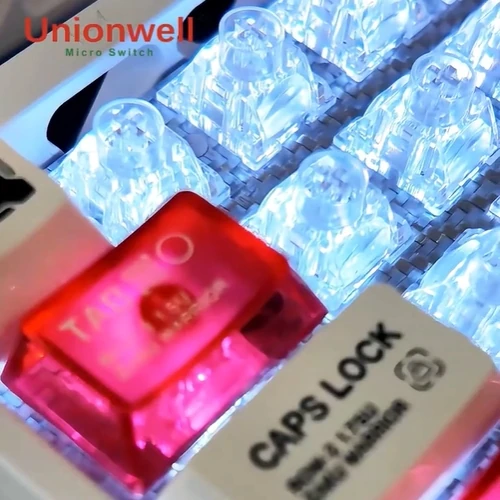
transparent keyboard switch lighting effect
Keyboard Switch Design for Light Transmission
Transparent materials can also serve as optical channels within the switch. Designers can map out light paths based on LED placement, creating a clear route for light to travel from the LED to the keycap. In the case of magnetic keyboard switches, the interior must also accommodate a magnet, a stem, and a non-magnetic spring.
Transparent light guides facilitate light transmission within a confined space while minimizing mechanical interference with magnetic sensing structures. Consequently, transparent materials serve not only to transmit light but also function as an integral part of the switch’s overall optical design.
Transparent Keyboard Switches Improve Internal Visibility
Transparent housings also enhance the visibility of the switch’s internal structure. Users can view components such as the stem, spring, and magnet through the casing—a feature that holds particular appeal for gaming and custom keyboards.
For designers, high internal visibility aids in observing the spatial relationships between components and helps identify potential assembly issues during development, assembly, and testing. However, while transparent keyboard switches offer both functional and aesthetic value, their technical significance remains rooted primarily in the requirements for light transmission and structural design.
How to Choose a Transparent Keyboard Switch?
Selecting a transparent keyboard switch should be based on actual keyboard requirements, with evaluations covering at least three aspects: RGB needs, material quality, and the intended application.
Check RGB Lighting Requirements
- Confirm if a transparent structure is truly necessary: If the keyboard features RGB back-lighting with LEDs positioned beneath the switches, a transparent structure offers more direct optical benefits.
- Check LED placement and keycap light-transmission areas: If a clear optical path exists between the LED and the keycap, transparent materials can further minimize light obstruction; conversely, if the keycaps themselves are opaque, the RGB advantages cannot be fully realized.
Therefore, RGB requirements should be evaluated in conjunction with the keycaps, LEDs, and the switches themselves.
Evaluate Material and Manufacturing Quality
When selecting transparent keyboard switches, one should not focus solely on the “transparent” appearance; material and manufacturing quality must also be assessed. Key factors include light transmittance, transparency, color consistency, dimensional accuracy, surface quality, and batch-to-batch stability.
Additionally, it is important to review the specifications, mechanical lifespan, and operating parameters provided by the keyboard switch factory. Only with consistent material properties and manufacturing processes can a transparent design achieve uniform visual and mechanical performance in mass production.
Consider Keyboard Switch Application Requirements
Selection should also be based on the specific application scenario. Gaming keyboards require a balance of RGB effects, fast actuation, durability for repeated use, and consistent keystroke feel. Custom keyboards may prioritize aesthetics, transparent structure, lighting effects, and typing feel. Office keyboards require a balance of lighting effects, typing feel, lifespan, and cost.
For magnetic keyboard switches, structural compatibility regarding the magnet, detection position, and light guide must also be verified. Ultimately, a transparent switch is not necessarily better simply because it is more transparent; the ideal choice strikes a balance between optical effects, mechanical performance, material quality, structural precision, and application requirements.
Conclusion
Some keyboard switches utilize transparent or semi-transparent materials primarily to enhance light transmission and RGB lighting effects, while also allowing for visibility of the internal structure and meeting product design needs. Transparent materials do not inherently provide superior switch performance. What truly matters is whether the material possesses adequate mechanical strength, dimensional stability, and light-transmission capabilities, and whether the manufacturing precision meets the requirements of the switch structure.
Therefore, when selecting keyboard switches, one should evaluate them across multiple dimensions, including material properties, dimensional accuracy, structural compatibility, RGB requirements, service life, and manufacturing consistency. Only when the transparent material aligns with the switch’s mechanical and optical structures—as well as specific application needs—can the true value of the transparent design be realized.