
Blog
The Function of Inductive Keyboard Switch in Modern Keyboards
In modern mechanical keyboards, gaming keyboards and high-performance keyboards have increasingly higher requirements for actuation speed, input stability, lifespan, and keystroke consistency. Inductive keyboard switches are emerging to meet these demands. They are keyboard switches that use inductive detection to identify keystrokes, and their signal detection method differs significantly from that of mechanical keyboard switches.
This article will focus on what an inductive keyboard switch is, its basic working principle, its main functions in modern keyboards, and its advantages and limitations, helping readers understand its practical application value in modern peripherals.
What Is an Inductive Keyboard Switch?
Basic definition and structure of an inductive keyboard switch
An inductive keyboard switch is a keyboard switch that uses inductive sensing to detect keystrokes. It identifies key states by changes in electromagnetic parameters caused by the movement of the switch, rather than relying on mechanical contacts to directly switch signals.
Its structure includes a switch stem, top housing, stainless spring, light guide, aluminum conductive rod, and bottom housing. When pressed, the stem moves the internal metal structure, causing the inductive sensing element on the PCB to detect the change. This, in conjunction with the signal processing circuit, controller, and firmware, completes input recognition.
Therefore, the core difference between an inductive keyboard switch and a mechanical keyboard switch lies not only in the switch structure but also in the trigger detection method and the overall coordination with the PCB and controller system.

inductive keyboard switch
How Inductive Keyboard Switch Differs from Mechanical Keyboard Switch
From a detection mechanism perspective, a mechanical keyboard switch primarily changes the circuit state through the contact and separation of metal contacts, with the PCB recognizing key input based on whether it is on or off. An inductive keyboard switch, however, does not rely on mechanical contacts to directly generate signals. Instead, it uses changes in parameters such as inductance and electromagnetic coupling caused by the movement of the switch, which are then converted into a recognizable signal by the detection circuit.
Therefore, even though both use similar stems, springs, and housings, they are not directly interchangeable. A mechanical keyboard switch requires a contact-type PCB, while an inductive keyboard switch requires a corresponding sensing circuit.
How Does an Inductive Keyboard Switch Work?
Key Press Movement Changes the Inductive Sensing State
When the user presses the keycap, the pressure is transmitted to the stem. The stem moves vertically along the housing rail and compresses the stainless spring. At this time, the aluminum conductive rod in the inductive keyboard switch moves with the stem, causing changes in parameters such as inductance and electromagnetic coupling in the sensing area.
The system identifies the key state by detecting changes in the detectable electromagnetic parameters caused by the position change. As the stem continues to move, the sensing system obtains signals corresponding to different positions. The PCB and firmware then process these signals to establish the relationship between key position, trigger point, and release state, providing the technical foundation for high-performance input functions.
The Keyboard Controller Processes the Inductive Signal
After the mechanical movement, whether the keyboard can accurately recognize input also depends on the back-end electronic system. The inductive sensing circuit on the PCB is responsible for detecting changes in sensing parameters and transmitting the processed data to the controller. The controller determines the key state according to preset logic and generates an input signal.
The process can be summarized as: Keycap Press → Stem Movement → Inductive Parameter Change → Sensing Circuit → Controller → Key Input Signal. The accuracy of the stem movement, the PCB sensing circuit, the controller, and the firmware all affect the detection performance. Therefore, the performance of an inductive keyboard switch cannot be judged solely by the switch itself; a complete match between the switch, sensing element, PCB, controller, and firmware is also required.
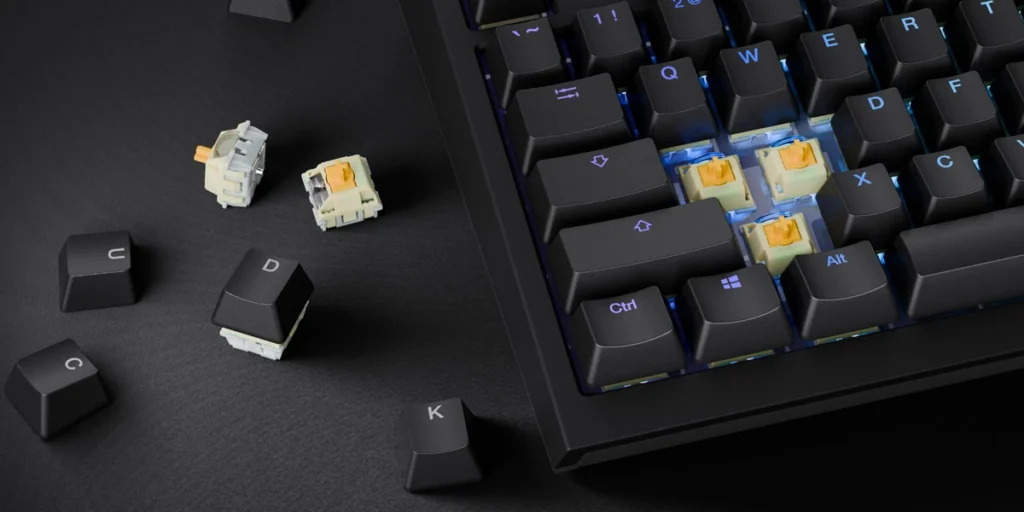
inductive keyboard
Inductive Keyboard Switch Can Support Precise Key Detection
The significant value of inductive detection lies in determining the key movement state through changes in sensing parameters. This provides the technical foundation for more refined trigger design in keyboard switches. The system can analyze the pressing process by combining stem movement position and determine valid triggers based on set parameters.
For gaming keyboards, this method provides more positional data for rapid pressing, releasing, and repeated triggering, and also provides a basis for firmware algorithm optimization. However, the actual detection accuracy still depends on the overall matching of the sensor, PCB, controller, firmware, and switch structure; it cannot be determined solely by using inductive detection.
What is the Function of an Inductive Keyboard Switch in Modern Keyboards?
An Inductive Keyboard Switch Provides Key Press Detection
Its most basic function remains recognizing the user’s key presses. For a keyboard input system, stable key press detection is the foundation for all subsequent functions. Only by accurately recognizing key presses can the keyboard further complete character input, game control, and shortcut key operations.
Compared to mechanical contact-based detection, the inductive keyboard switch focuses on the relationship between the switch movement and the sensing parameters. Therefore, the system can establish more detailed signal judgment logic according to actual design requirements, providing a technical foundation for the subsequent development of more new functions.
An Inductive Keyboard Switch Supports Consistent Input Performance
Gaming keyboards and high-frequency input devices need to withstand a large number of repetitive presses. Therefore, the inductive keyboard switch not only needs to achieve stable triggering but also needs to maintain consistent motion feedback.
Its consistency depends on several factors: the precision of the fit between the stem and housing affects the movement trajectory; the spring’s elasticity affects pressing and rebound; the matching of the sensing element and the PCB detection circuit affects signal stability; and the controller and firmware determine the processing effect of the sensed data. Therefore, the consistent performance of an inductive keyboard switch is the result of the combined effect of its mechanical structure and electronic detection system.

Inductive Keyboard Switch Supports High-Performance Keyboard Applications
For e-sports, high-speed input, and high-frequency operation scenarios, users are particularly concerned about its Trigger Response, Input Consistency, Key Feel, Repeatability, and Mechanical Life.
Inductive keyboard switches can serve as high-performance keyboard solutions, but their actual performance requires a holistic evaluation of the switch, PCB, controller, and firmware. Even if the keyboard switch has high detection resolution, signal processing delays will affect input response. Therefore, keyboard switch manufacturers need to consider both the mechanical structure and the electronic detection system.
Advantages of Inductive Keyboard Switch
Reduces Dependence on Mechanical Contacts
A key feature of inductive keyboard switches is that their input detection does not rely on direct contact and separation of mechanical metal contacts. This provides a different input detection solution for gaming keyboards, especially suitable for high-frequency pressing and fast-response scenarios.
However, not relying on metal contacts does not mean there is no mechanical wear. Components such as the stem, housing, and spring will still move over a long period, so their specific mechanical life still depends on materials, structural design, and manufacturing processes.
Offers Consistent Key Detection
If the inductive sensing element, PCB, and controller are well-matched, inductive detection can achieve stable input detection. Its consistency is reflected in the detection threshold, repeated triggering, and long-term signal performance. If the same key produces different results in the same location, it may cause premature triggering, delayed triggering, or abnormal release. Therefore, the consistency of an inductive keyboard switch also depends on manufacturing tolerances, stem movement accuracy, sensing element position, PCB design, and firmware calibration.
Inductive Keyboard Switch Provides Rapid Trigger
Rapid triggering is a crucial feature of high-performance keyboards. Its core function isn’t simply shortening the fixed actuation distance, but rather more promptly determining the key’s state based on positional changes during key press and release.
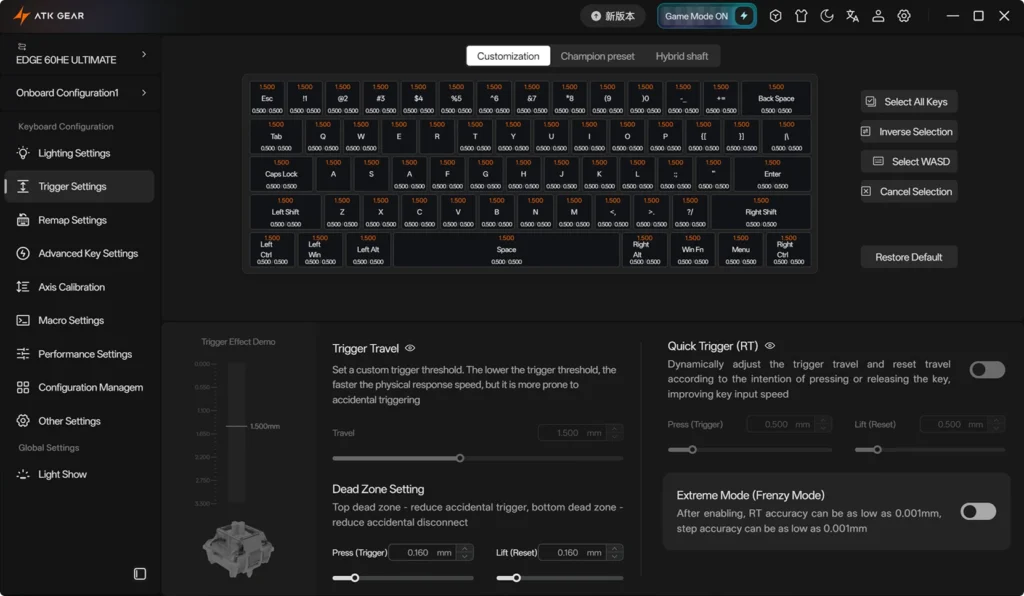
rapid trigger
For inductive keyboard switches, the sensing system continuously acquires information about switch movement and related parameter changes, which are then used by the controller and firmware to determine the press, release, and re-trigger status. This approach is more suitable for FPS games, fast movement, and high-frequency repetitive input, reducing re-trigger limitations. However, the actual performance of rapid triggering also depends on the sensor, PCB, controller, firmware, and trigger parameter settings.
Disadvantages and Limitations of Inductive Keyboard Switch
While inductive keyboard switches have their own technical characteristics, their applications also have significant system limitations. Compatibility is a primary concern, especially for DIY enthusiasts and users looking to replace their switches.
Inductive Keyboard Switch Requires Compatible PCB and Controller
One of the main limitations of inductive keyboard switches is the need for a compatible dedicated PCB and controller. It relies on an inductive sensing circuit to acquire and process sensor parameters, rather than traditional mechanical contacts.
Therefore, the complete system involves the switch, sensing circuit, PCB, controller, firmware, and signal processing. If only the switch is replaced, but the original PCB lacks the corresponding sensing circuit, even if the switches can be installed, they will not be able to properly recognize input.
Inductive Keyboard Switch May Have Limited Compatibility
Because the detection method is highly dependent on the PCB platform, the compatibility of inductive keyboard switches cannot be judged solely by their appearance. When switching between different brands or series, the switch structure, sensing method, PCB compatibility, controller compatibility, and firmware support should be confirmed.
Firmware and controller compatibility is especially important for products supporting Rapid Trigger or Adjustable Actuation Point. Note that “able to install” does not equal “able to recognize”: the former pertains to mechanical compatibility, while the latter requires coordinated support from the PCB, sensing circuit, controller, and firmware.
Inductive Keyboard Switch vs Mechanical Keyboard Switch Comparison Table
To more intuitively understand the differences between the two types of keyboard switches, the following table can be used for comparison:
|
|
Inductive Keyboard Switch |
Mechanical Keyboard Switch |
|
Core detection methods |
Changes in inductance/electromagnetic parameters |
Changes in mechanical contacts |
|
Main detection structure |
Inductive Sensing Element |
Metal Contact |
|
PCB Requirements |
Requires matching inductive detection circuitry |
Requires matching contact circuitry |
|
Controller Requirements |
Requires processing inductive signals |
only processing switch inputs |
|
Compatibility |
Currently, fewer compatible keyboards |
multiple solutions exist depending on the keyboard specifications |
|
Mechanical Contact Dependence |
None |
High |
|
DIY Replacement Difficulty |
Relatively High |
Depends on PCB and Mounting Specifications |
|
Application |
Specific high-performance or custom keyboards |
most mechanical keyboards on the market |
As the table shows, the two types of keyboard switches utilize different detection technologies. Inductive keyboard switches rely more on sensing circuits, controllers, and firmware, resulting in higher system integration. Mechanical keyboard switches, on the other hand, rely on metal contacts to determine electrical state changes, and their compatibility assessment primarily revolves around contact structure, pin layout, mounting structure, and PCB circuitry.
Conclusion
The core function of an inductive keyboard switch is to use inductive detection technology to identify key movements and convert the mechanical displacement of the stem into electronic signals that the keyboard control system can process. This detection method further supports features such as adjustable actuation points and rapid triggers, making it more suitable for gaming keyboards.
With the continuous development of gaming keyboards and high-performance input devices, user demands for fast triggering, accurate detection, stable input, and long-term reliability will continue to grow. For keyboard switch manufacturers, only by combining sensing technology, mechanical structure, electronic systems, and precision manufacturing processes can they provide more stable, reliable, and practically valuable inductive keyboard switches.