
Blog
What’s the Difference Between Factory Lubed and Hand Lubed Keyboard Switch
For mechanical keyboard users, the lubrication of the keyboard switch directly affects the friction between the internal components, thus altering the smoothness of key presses, spring noise, tactile feedback, and sound. Especially during extended typing or gaming sessions, proper lubrication significantly impacts the user’s perception of the switch’s quality.
Currently, keyboard switch lubrication methods can be broadly categorized into two types: Factory Lubed Keyboard Switches and Hand Lubed Keyboard Switches. They differ significantly in lubrication methods, lubrication amount control, production efficiency, and post-tuning flexibility. This article will analyze them from both manufacturing process and actual user experience perspectives to help you determine which solution best suits your needs.
What Does Lubing Mean for a Keyboard Switch?
A keyboard switch contains multiple components, including a stem, spring, and housing. When pressed, the stem moves along a guide rail within the housing, while the spring compresses and rebounds. Significant dry friction between these components can produce a grating sensation, noise, and uneven resistance.
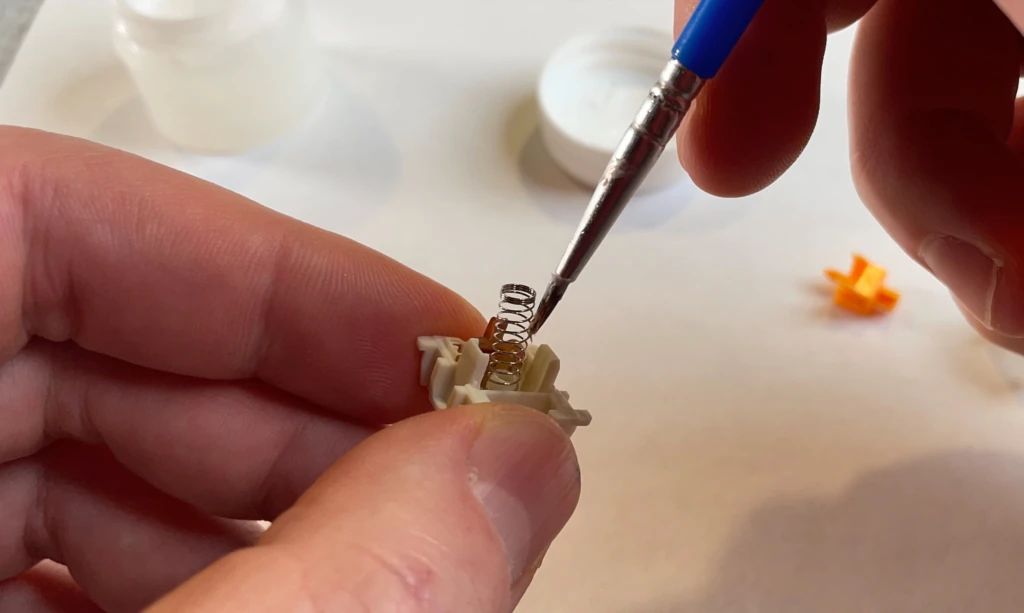
hand lubed keyboard switch
Lubricant on a keyboard switch reduces friction and mechanical noise by applying appropriate lubricant to suitable locations. It’s important to note that lubrication is not simply applying oil; the viscosity, application location, and amount of lubricant all affect the final feel and performance.
Where Is Lubricant Applied in a Keyboard Switch?
Common lubrication areas in a keyboard switch include the stem rails and sliding surfaces, the springs, and some contact areas inside the housing:
- The stem moves up and down along the internal structure of the housing. Excessive friction on the rails can cause a scraping sensation; appropriate lubrication improves smoothness.
- The springs may rub against other components during compression and rebound; proper lubrication helps reduce spring-ping noises.
- Some contact areas of the housing also affect performance. Insufficient lubrication increases friction, while excessive lubrication can create damping, making the switches feel dull and slowing the rebound.
In conclusion, lubrication is not about covering as much area as possible; it should be precisely applied to the actual friction points.
How Lubing Changes Keyboard Switch Feel and Sound
Proper lubrication affects the smoothness and feel of the keyboard switch. Adequate lubrication reduces friction as the stem moves within the housing, resulting in smoother pressing of the linear keyboard switch and reduced graininess and scratching. Lubrication also improves friction and mechanical noise generated by the stem, housing, and spring.
However, it’s crucial to understand that more lubrication is not always better. Insufficient lubrication fails to reduce friction, while excessive lubrication increases resistance and can even cause the switches to become sticky and slow down their rebound. Therefore, the appropriate type, viscosity, and amount of lubricant should be selected based on the switch structure, materials, and desired feel.
What Is a Factory Lubed Keyboard Switch?
A factory lubed keyboard switch refers to a switch that has been pre-lubricated by the manufacturer during the production phase. The lubrication process is typically integrated into the manufacturing, assembly, testing, or packaging stages.

factory lubed keyboard switch
This is not simply pre-lubrication; rather, it involves standardized processes to control the type, area, and amount of lubricant, combined with assembly and performance testing, to ensure consistent switch performance. Therefore, a mature factory lubed keyboard switch solution is essentially part of a complete manufacturing process.
How Factory Lubing Is Applied to Keyboard Switches
In the factory, keyboard switch lubrication requires standardized processes based on the switch structure:
- Manufacturers need to select appropriate lubricants based on the materials of the stem, housing, and spring, and the target feel, to avoid affecting the damping effect.
- Clearly define the lubrication areas, such as focusing on the sliding friction of the stem rails while avoiding contamination of contact areas, etc.
- Insufficient lubrication may lead to inconsistent feel, while excessive lubrication will increase damping; standardized processes are needed to ensure consistency for each switch.
- After lubrication, the switches still need to undergo assembly and performance testing, including actuation force, rebound performance, and trigger stability.
Therefore, the value of Factory Lubed Keyboard Switches lies not only in reducing the number of steps users need to adjust later, but also in integrating the lubrication process into the manufacturing quality system, ensuring stable and consistent product performance.
Advantages and Limitations of Factory Lubed Keyboard Switches
The biggest advantage of Factory Lubed Keyboard Switches is their convenience. Users can install and use them directly without disassembling the switches or re-lubricating them. For mass-produced mechanical keyboards, standardized lubrication processes can also improve assembly efficiency, reduce manual handling, and enhance product consistency through uniform lubrication locations, amounts, and testing procedures.
However, Factory Lubed also has certain limitations. Because the lubrication scheme is pre-set by the manufacturer, users cannot control the type, viscosity, and amount of lubricant. Therefore, for users seeking a highly personalized feel, these keyboard switches still offer room for further adjustment.
What is a Hand-Lubed Keyboard Switch?
A hand lubed keyboard switch refers to a keyboard switch that the user disassembles and manually lubricates components such as the switch housing, springs, and housing. Compared to factory lubrication, it allows users to choose the lubricant, adjust the lubrication location and amount according to their individual needs, thus more precisely improving the smoothness, damping feel, and sound performance of the switches, making it more suitable for keyboard enthusiasts who pursue a personalized feel.
How to Hand Lube a Keyboard Switch?
When manually lubricating a keyboard switch, you need to first disassemble the switch housing, remove the switch housing, and then treat the sliding and friction areas separately. When lubricating the switch housing, apply a thin and even layer of lubricant. For the springs, you can perform special treatment according to your desired feel. For the housing, you can also apply lubricant appropriately to the actual friction areas (such as the rails). Only after completing these steps can you reassemble and test the results.
The amount of lubricant used is crucial. Too little will fail to improve friction, while too much may increase damping, making the feel heavier, the sound muffled, and even affecting rebound. Therefore, the focus of Hand Lubed is not on adding more lubricant, but on precisely controlling the type, location, and amount of lubricant according to the switch structure.
Why Hand Lubing Gives More Control Over Keyboard Switch Feel
The biggest advantage of Hand Lubed Keyboard Switches is their adjustability. Users can choose the type and viscosity of lubricant, as well as the treatment of different components, according to their individual needs. For example, adjusting the Stem movement area or treating the Spring separately can optimize smoothness, damping feel, and sound performance.
Compared to Factory Lubed, Hand Lubed offers a more personalized feel experience, making it more popular with custom enthusiasts and DIY users. However, it also means requiring more time, tools, and lubrication experience.
Factory Lubed vs Hand Lubed Keyboard Switch: Key Differences
There isn’t a simple superior-inferior relationship between factory lubed and hand lubed keyboard switches. The core difference lies in their focus: the former emphasizes standardized production and ease of use, while the latter emphasizes manual adjustment and personalized control.
Keyboard Switch Lubrication Consistency
The consistency of factory lubeds relies primarily on standardized production processes. Manufacturers reduce variations between switches by standardizing lubricants, their placement, dosage, and testing procedures. However, the final performance still depends on machining precision and quality control levels. While hand lubeds allow for adjustments to individual switches, achieving greater personalization, their effectiveness is highly dependent on operator experience, and variations in lubrication levels can lead to inconsistencies.
Keyboard Switch Feel and Smoothness
Factory lubed keyboard switches are typically lubricated according to the manufacturer’s preset target feel, providing users with a relatively consistent smoothness from the out of the box.
Hand lubeds, on the other hand, allow users to further adjust the friction feel. For example, users can apply more precise lubrication to the stem rails to reduce friction in certain areas. However, improper lubrication can also have negative effects with hand lubrication. The greater the freedom in manual lubrication, the higher the skill required for operation.
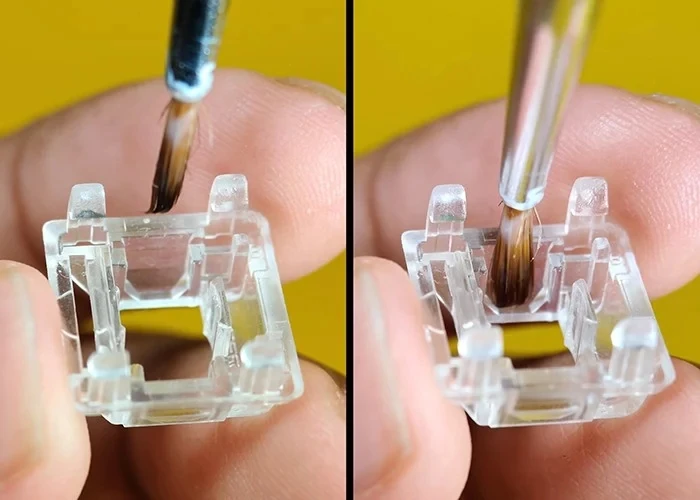
lube keyboard switch housing
Keyboard Switch Sound Performance
Lubrication affects the sound performance of a keyboard switch, but it’s not the only factor. Friction between the stem and housing, spring vibration, and component impacts all generate noise.
Proper lubrication can reduce some friction noise and make operation more stable, but the final result depends on the overall structure of the housing, stem, spring, keycap, plate, and case. Therefore, hand lubrication is not necessarily superior to factory lubrication; the real factor affecting the result is the matching between the entire keyboard system and the lubrication solution.
Keyboard Switch Customization and Adjustment
In terms of adjustability, the two differ significantly. Factory-lubed keyboard switches have a pre-set lubrication scheme from the manufacturer, making them convenient to use, but offering limited room for later adjustments. Hand-lubed keyboard switches, on the other hand, allow users to freely choose the lubricant, viscosity, location, and amount, adjusting the feel and sound according to individual needs.
In conclusion, the two technologies cater to different user needs. Factory Lubed is more geared towards standardized production, while Hand Lubed is better suited for personalized tuning.
Factory Lubed vs Hand Lubed Keyboard Switch: A Practical Comparison
|
Comparison Projects |
Factory Lubed Keyboard Switch |
Hand Lubed Keyboard Switch |
|
Lubrication method |
Factory batch processing |
manual individual processing |
|
Ease of use |
High, can be used directly |
A little low, requires disassembly and adjustment |
|
consistency |
Depends on manufacturing process and quality control |
Depends on operator experience |
|
Adjustability |
Relatively limited |
High |
|
Time cost |
low |
high |
|
Suitable for |
General users, mass-produced keyboards |
custom enthusiasts, DIY users |
|
Mass production |
More suitable |
Not recommended |
|
Personalized Adjustment |
Limited |
Flexible |
In practical use, Factory Lubed isn’t necessarily worse than Hand Lubed. The final performance depends on the lubricant, lubrication level, switch structure, manufacturing precision, materials, and the user’s skill level.
Factory Lubed vs Hand Lubed Keyboard Switch: Which One Should You Choose?
Factory Lubed Keyboard Switch Is Better for Convenience
Factory Lubed Keyboard Switches are more suitable for users new to mechanical keyboards or those who don’t want to adjust them themselves. Since the lubrication process is done by the manufacturer, users can use it directly without disassembling the switches.
For keyboard manufacturers, Factory Lubed is also more suitable for mass production, improving efficiency and product consistency through standardized processes. With a stable production process and quality control, Factory Lubed Keyboard Switches generally provide reliable smoothness.
Hand Lubed Keyboard Switch Is Better for Customization
Hand Lubed Keyboard Switches are more suitable for customization enthusiasts, DIY users, and those who demand high-quality feel and sound. Users can choose the appropriate lubricant and adjust the handling of components like the stem and spring to optimize friction, damping, and sound performance.
However, this method requires more time, experience, and structural knowledge. In other words, the core advantage of hand lubeds lies in their greater adjustability, rather than inherently higher performance.
Conclusion
Factory lubeds and hand lubed keyboard switches are not necessarily better in one case than the other; they represent different lubrication methods and usage needs. Regardless of the method used, the final result depends on the precision of the switch structure, materials, lubricant, lubrication quantity, and quality control. For keyboard switches, proper lubrication is only one part of overall performance; stable structural design and precision manufacturing are equally important.
As the mechanical keyboard and custom market continues to grow, user demands for smoothness, sound quality, and consistency will further increase. For keyboard switch suppliers, continuously improving switch structure precision, lubrication processes, batch consistency, and quality control capabilities is crucial to providing stable, smooth products that meet the specific needs of various applications.